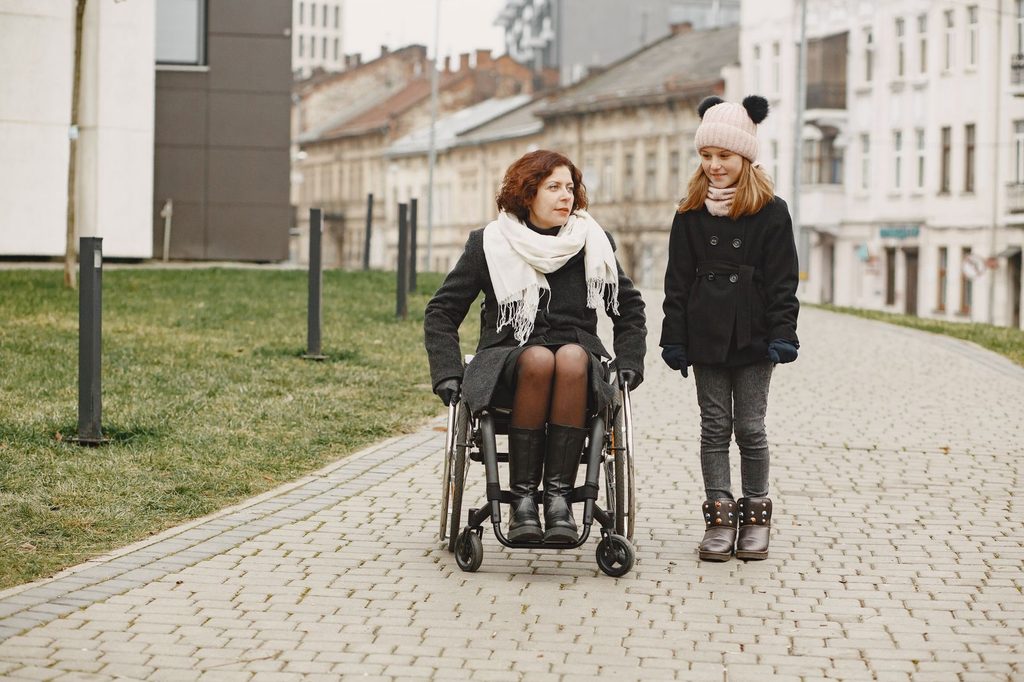
When you are planning a trip with a wheelchair, a walking frame, poor eyesight or simply a knee that has just been operated on, the question is not "what is beautiful in Bratislava" but "can I get there, and what will I find when I do". Research published in 2025 in the Journal of Destination Marketing & Management (Rubio-Escuderos et al.) looked at exactly this problem and showed that physical barriers are only part of it: destinations are held back just as much by information systems that fail to give detailed data about venues and their adaptations.[1] On that front Bratislava is ahead of many cities, but hardly anyone knows about it. This article sums up what can be verified from official sources, and it also says the uncomfortable part: where you will not get in.
Article contents
- Check accessibility before you travel
- Arriving and getting around the city
- Landmarks and museums: what is accessible and what is not
- The centre on foot: paving, gradients and orientation
- Where to find accessible toilets
- Car, parking, transport services and equipment
- Where to stay without stairs
- Frequently Asked Questions (FAQ)
- Sources
Check Accessibility Before You Travel
The most useful document on accessibility in Bratislava is not in the tourist guidebooks. It is published by the city under the name Information on Accessibility in Bratislava and its current version has been valid since 30 November 2024. Accessibility in it is not assessed by a marketing department but by specialists, and across six areas at once: Mobility, Sight, Hearing, Activities, Toilets and Transport.[2]
Each area has three possible ratings, and that is exactly what makes the document usable:
- 🟢 Yes means accessibility meets the standard or has only minor shortcomings you can get past.
- 🟡 Partly means only part of the site or service is accessible and some obstacles call for assistance.
- 🔴 No means the site is not accessible.
The ratings rest on specific numbers, not impressions. For a ramp to get a "Yes" it must have a gradient of no more than 1:12, a clear width of at least 1 metre and handrails on both sides at a height of 0.9 metres. A lift must have a car of at least 1.1 × 1.4 metres, automatic doors, floor announcements and Braille markings on the buttons. An accessible toilet must have a cubicle of at least 1.4 × 1.8 metres, a door 0.8 metres wide and a seat height of 0.5 metres.[2] So when you see "Partly" next to a site, the description tells you exactly what the problem is: a threshold, the door width or a missing handrail.
The second source is the English page Accessible tourism in Bratislava by Visit Bratislava, which sorts tourist sites into three colours: fully accessible, partly accessible and not accessible.[3] It is especially handy for international visitors.
Arriving and Getting Around the City
Public transport is a surprisingly strong point in Bratislava. According to the data behind the city document, 100% of buses, trolleybuses and minibuses and roughly 50% of trams are low-floor, and these vehicles are equipped to carry wheelchair users, people with pushchairs and people with visual and hearing impairments.[2] Low-floor services are marked with a pictogram in the timetables and in the apps, so you can pick a specific departure in advance.[4]
The rules for boarding with a wheelchair are simple, but you need to know them: you board through the door with the wheelchair pictogram and always with the driver's knowledge, signalling to them verbally or by gesture. Inside the vehicle you put the brakes on and secure the wheelchair with the safety belt. If the vehicle has a fold-out lift, you press the button with the pictogram and the driver is obliged to use the lift and help you.[5] For more on tickets, zones and services from the airport, see our article Transport in Bratislava.
When arriving in the city, it pays to know how the individual terminals fare:
Landmarks and Museums: What Is Accessible and What Is Not
This is where we differ most from ordinary guidebooks: we list not only where you can get in, but also where you cannot. It will save you a trip across town.
One more thing worth asking about: in many museums, holders of a disability card get in free.[3] It is not always stated in an obvious place, so ask at the ticket desk. You will find an overview of further exhibitions in our article Museums and Galleries in Bratislava, and if you are drawn to panoramas, a comparison of the places the city can be seen from is in the article The Best Views and Viewpoints in Bratislava.
The Centre on Foot: Paving, Gradients and Orientation
The historic core of Bratislava is small and essentially flat, which is good news for moving around in a wheelchair. Even so, there are differences within a few hundred metres.
Where it is comfortable
The Main Square, Primate's Square and Franciscan Square are rated "Yes" for mobility in the city assessment: even paving, flat ground or a gentle slope, benches, places to eat and events.[2] If you are planning a shorter loop around the centre, build it around exactly these three. You can put a route together using the article Bratislava Old Town: What to See on Foot.
Where it will be harder
Hviezdoslavovo Square is rated "Partly", because the stone paving is demanding in places and the nearest public toilet is over on Uršulínska Street. The walking route to St Martin's Cathedral came off worst: from Rybné Square there is a long steep ramp with a handrail, and the pavements have large stone cobbles and kerbs with no dropped sections.[2] So plan the cathedral for early in the day, while you still have energy.
If you have impaired sight or hearing
This is the weaker point of the centre: the squares have only natural guiding lines (the edge between the pavement and a building or a lawn); there is no coherent artificial guidance system. On the other hand, the Tourist Information Centre on Klobučnícka Street has a tactile map, talking tactile blocks and special magnifiers, and the same talking tactile models of buildings with audio commentary can be found in the Old Town Hall.[2]
For deaf and hard-of-hearing visitors it matters that both the Tourist Information Centre and the Old Town Hall offer online transcription and sign language interpreting right at the counter and on the information line. The public transport operator's info centre provides the same service.[2] The Tourist Information Centre also lends out a walking frame, which older visitors in particular will appreciate.
Where to Find Accessible Toilets
A toilet decides how long your day in the city lasts more than any landmark does. Bratislava has more of them than it first seems, but most cubicles are locked and you have to ask the attendant or ask for a key.[2]
- 🚻 Uršulínska Street is the closest public toilet to the Main Square. The cubicle is on the small side, the seat height is 50 cm, and there is a baby-changing table and an attendant.
- 🚻 Janko Kráľ Park: a public toilet in the basement, reached by an inclined lifting platform with an attendant, separate men's and women's facilities, seat height 50 cm.
- 🚻 Transport hubs: the Main Railway Station (key at reception), the Nivy bus station (unlocked by staff) and the airport.
- 🚻 Cultural institutions: the Old Town Hall, the Mirbach and Pálffy palaces, the P. O. Hviezdoslav Theatre, the Old Market Hall and the City Library.
- 🚻 Shopping centres Aupark, Eurovea and Central, plus Park JAMA and the Kamzík recreation area.
Car, Parking, Transport Services and Equipment
If you are arriving by car, the city publishes specific streets with parking spaces reserved for people with disabilities, for example Žabotova, Železničiarska, Bukurešťská, Holekova, Murgašova, Jelenia, Palárikova and Čajakova, and it also rates the Centrum and Tatracentrum underground car parks and the P+R park-and-ride sites in Petržalka, Krasňany and Vrakuňa.[2] How the PAAS zones work and where it is better to avoid parking altogether is covered in our article Parking in Bratislava.
Two services visitors most often do not know about:
- 🚐 Transport service with a lift-equipped vehicle and assistance. The vehicles have a fold-out ramp or an electro-hydraulic platform and securing equipment; they can carry one person in an electric wheelchair or two people in manual wheelchairs plus two or three accompanying people. The service is run by non-profit organisations (for example Opatrovateľka n.o., ARES or Hospic Slnečnica) and has to be booked in advance, on working days.
- 🦽 Rental of mobility equipment. If you would rather not haul your own wheelchair or walking frame halfway across Europe, you can borrow one, for example from the Bratislava Archdiocesan Charity, the Organisation of Muscular Dystrophy Patients in Slovakia, the Mosty Pomoci association or the Slovak Union of the Physically Disabled. The Slovak Blind and Partially Sighted Union has a branch right in Bratislava.
The opening hours of these organisations are limited (usually mornings on working days), so get in touch well ahead, not the day before you arrive. Current contact details are in the city document and on the individual organisations' websites.[2]
Where to Stay Without Stairs
Accommodation is the last piece of the puzzle and also the one where an unpleasant surprise happens most often: "ground floor" in a listing sometimes means a few steps at the entrance. So here is how it is with us, stated plainly.
You can reach two apartments without stairs. BAGRA on Bagarova Street is on the ground floor, looks out onto greenery and lists barrier-free access on its page. DONIO in Donovaly is also on the ground floor with a step-free entrance, which is handy if you want to combine Bratislava with a stay in the mountains.
The other apartments are on upper floors, but in buildings with a lift: SADBA on the 2nd floor, and LUCAO, FIAOR and CASTE in the new building on Zámocká Street. BRIS on Prístavná Street is on the 6th floor and the apartment door is directly opposite the lift, which in practice means minimal manoeuvring in the corridor.
Every apartment comes with self check-in, so there is no waiting at a reception desk and no adjusting to someone else's arrival times, and parking is included in the price, which matters when you have a car with a lift.
Let's be precise: our apartments are not certified as barrier-free and we do not measure them against the criteria the city uses. If you need to know a specific door width, bathroom dimensions or the height difference at the entrance, write to us before you book and we will check. We would rather tell you it is not a fit than have you find out on the spot with your suitcases.
Frequently Asked Questions (FAQ)
Is Bratislava Castle wheelchair accessible?
According to the Visit Bratislava overview, Bratislava Castle is among the fully accessible sites: there is a ramp at the entrance and a lift and a wheelchair-accessible toilet inside. At the entrance itself you may still need help from a security officer. The castle grounds are flat, so moving around the courtyards and the baroque garden is usually comfortable. Check the current conditions with the operator before your visit.
Are there low-floor trams and buses in Bratislava?
According to city data accompanying the document valid from 30 November 2024, 100% of buses, trolleybuses and minibuses and roughly 50% of trams are low-floor. Low-floor services are marked with a pictogram in the timetables and in the apps. Board through the door with the wheelchair pictogram and make sure the driver knows, by signalling to them; inside the vehicle put the brakes on and secure the wheelchair.
Where can I find an accessible toilet in the centre of Bratislava?
The nearest public accessible toilet to the Main Square is on Uršulínska Street; the cubicle is on the small side, the seat height is 50 cm and there is a baby-changing table and an attendant. Others are in the Old Town Hall and the Mirbach Palace (ask for the key at reception), in the Old Market Hall, at the Main Railway Station, at the Nivy bus station, at the airport, in Janko Kráľ Park and in shopping centres. Expect many cubicles to be locked, so you will need to ask the attendant.
Where can I check the accessibility of a specific building in Bratislava?
The City of Bratislava publishes a document called Information on Accessibility in Bratislava with a list of assessed sites, valid from 30 November 2024. Each site comes with a table rating the areas Mobility, Sight, Hearing, Activities, Toilets and Transport on three levels: Yes, Partly and No. Visit Bratislava also has an English overview of attractions with a colour rating.
Which apartment suits a guest who cannot manage stairs?
You can reach two apartments without stairs: BAGRA on Bagarova Street, which is on the ground floor and lists barrier-free access on its page, and DONIO in Donovaly, which is also on the ground floor and has a step-free entrance. The other apartments are on upper floors in buildings with a lift. The apartments are not certified as barrier-free, so if you need specific door or bathroom dimensions, write to us in advance and we will check them.
Conclusion
Accessible Bratislava is not perfect, but it is well documented, and for planning a trip that matters more. You can find out in advance that you will get to the Main Square comfortably, that the UFO observation deck is out, that the Old Town Hall works with a bit of help at the ramp, and that you should build in a stop at the toilet on Uršulínska Street. Add step-free accommodation and a self check-in, and you will have energy left in the day for what you actually came for. If you are unsure about anything, write to us before you book. For programme ideas, see the article What to See in Bratislava.
Sources
- Rubio-Escuderos, L., Ullán de la Rosa, F., & García-Andreu, H. (2025). What is stopping the process? Analysis of obstacles to accessible tourism from a stakeholders' perspective. Journal of Destination Marketing & Management, 36, 100879. doi.org/10.1016/j.jdmm.2024.100879.
- City of Bratislava: Informácie o bezbariérovosti Bratislavy, list of assessed buildings and spaces, valid from 30 November 2024 (PDF). List of buildings (PDF), overview at bratislava.sk.
- Visit Bratislava: Accessible tourism in Bratislava (attractions rated by accessibility). visitbratislava.com.
- Dopravný podnik Bratislava: Bezbariérové cestovanie. dpb.sk.
- imhd.sk: Bezbariérová doprava v Bratislave (boarding rules, marking of services). imhd.sk.
The accessibility ratings reflect assessments valid at the date of the sources, and the operation of individual sites can change, for example during renovations. Check the situation before your visit on the website of the specific place or by phone.