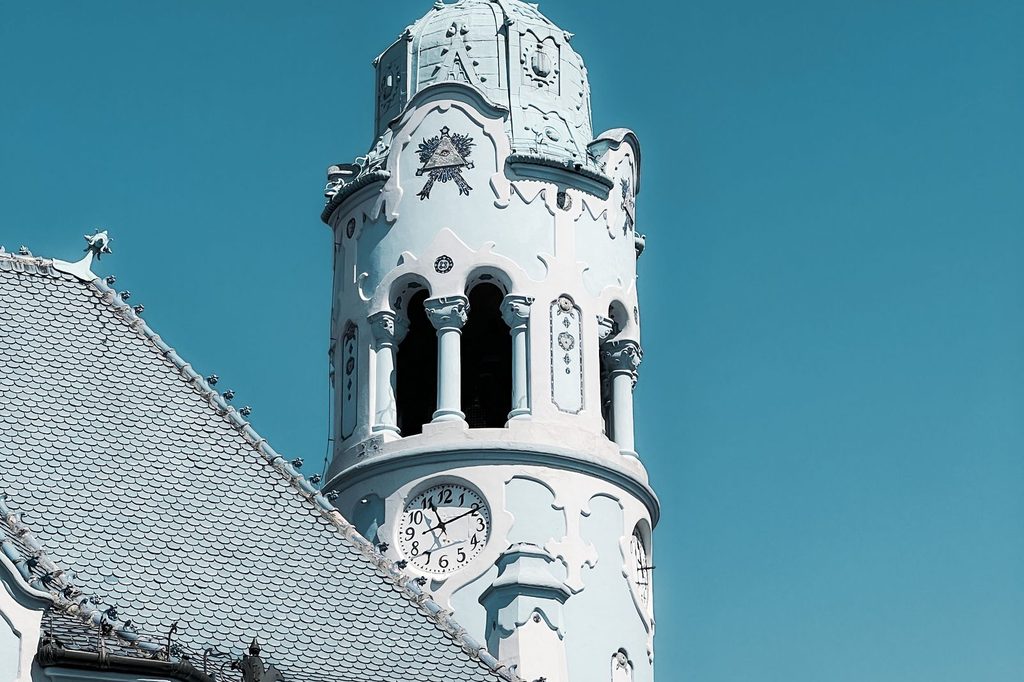
The Blue Church is probably the most photographed building in Bratislava that isn't the castle. It isn't large, it doesn't sit on a square or a hill, and it is easy to miss on the usual tourist route – and yet people seek it out on purpose. The reason is simple: you won't see anything like it anywhere else. Pale blue plaster, blue glazed roof tiles, rounded shapes without a single sharp corner and ceramic ornament that looks like cake icing make it one of the most distinctive Art Nouveau buildings in Central Europe. This guide covers what to look out for, when you can actually get inside, how to get there and what else is worth adding to your plan.
Article contents
History: a Church for St Elizabeth
The church is dedicated to St Elizabeth of Hungary, daughter of the Hungarian king Andrew II, who was born in Bratislava and became known for caring for the poor and the sick. The building was meant to be her symbolic memorial in her home city, and the whole decorative scheme follows that idea, including the recurring rose motif.[3]
It was built between 1909 and 1913 and consecrated on 11 October 1913.[2] Originally it was not a separate parish church in today's sense: it was created as part of a school complex together with the grammar school that stands nearby on Grösslingová Street and was designed by the same architect. Only later did it become a full parish church, which it remains to this day. Since 1963 it has been listed as a national cultural monument.[3]
The fact that this is a working parish church and not a museum is the key to planning your visit. It isn't open all day like a gallery, and you'll only see the interior at certain times – more on that below.
Architecture: What to Look for Outside and Inside
The design is the work of Ödön Lechner (1845–1914), a leading figure of Hungarian Art Nouveau who sought to create a "national" architectural language by blending Art Nouveau with folk and oriental motifs. The Blue Church is among his last major completed works.[3]
The exterior
The facade is made up of layered plasterwork in various shades of blue and white, divided into softly framed panels. The blue continues onto the roof, which is covered with glazed ceramic tiles. Adjoining the single-nave building is a cylindrical tower 36.8 metres high.[2] On the main front there is a mosaic of St Elizabeth with roses in her arms – the same scene is repeated on the main altar.
Details people overlook
- 🌹 The rose motif returns on the facade, on the railings and inside. It refers to the legend of St Elizabeth, whose bread for the poor turned into roses.
- 🏛️ No sharp edges. Lechner shaped the openings, cornices and balustrades into soft curves, which makes the building feel more like a ceramic object than a piece of architecture.
- ⛪ The dome that isn't there. The original design called for a large dome; in the end it was replaced by a barrel vault of oval profile with a steep roof. The little cupola above the pulpit is a miniature of what might have been.[3]
- 🧱 Modern engineering in an Art Nouveau shell. The vaults are reinforced concrete – a progressive solution in the early 20th century, hidden beneath an ornamental surface.[3]
- 🖼️ The art inside: the altarpiece showing St Elizabeth giving alms was painted by Július Túry (1911), and the side altar is decorated with a polychrome relief by the Bratislava sculptor Alojz Rigele.[3]
If Art Nouveau has caught your interest, it is worth also looking at the parish house next to the church and the grammar school building on Grösslingová mentioned above. They belong to the same building project and together form a coherent architectural ensemble unlike anything else in Bratislava. For more ideas on what to fit into your time in the city, see our article What to See in Bratislava.
Opening Hours, Admission and Guided Tours
This is the most common reason visitors leave disappointed: they arrive in the afternoon, the church is locked and they go away with nothing but a photo of the outside. The Blue Church is not an all-day attraction. It is normally open to the public only in short windows around services, according to the parish schedule:[1]
| Day | Church open | Masses |
|---|---|---|
| Monday – Wednesday | 6:30 – 7:30 | 7:00 |
| Thursday – Friday | 17:30 – 19:00 | 18:00 |
| Saturday | 6:30 – 7:30 | 7:00 |
| Sunday | 7:30 – 11:00 and 17:30 – 19:00 | 8:00, 10:00, 11:30 (in English), 18:00 |
Schedule according to the official parish website (as of August 2026). Times change during religious holidays, so check them before your visit at modrykostol.fara.sk.
There is no admission charge. The church has no ticket office and no turnstiles; the only thing asked of you is to keep quiet and respect any service in progress. If you arrive during mass you may go in, but it is not the time for photography or for looking around the interior.
Guided tours with music
In the summer season the parish organises guided tours combined with music. In August 2026, according to official information, they were scheduled from Monday to Saturday between 10:00 and 19:00, every half hour. No reservation is needed and tickets are sold on the spot.[1] This is a seasonal arrangement, so always check the current dates and price on the parish website. If it works out for you, it is by far the best way to get inside and have enough time to take the interior in properly.
How to Get to the Blue Church
The church stands on Bezručova Street on the eastern edge of the Old Town, a short distance from Grösslingová and Dostojevského rad.[2] So it isn't directly on the main tourist axis, but it is only a short walk from it.
- 🚶 On foot from the centre: from the Main Square or from St Michael's Gate it is a pleasant walk of roughly 10–15 minutes. From the Eurovea shopping centre and the Danube embankment it is much the same.
- 🚌 Public transport: the nearest stops are around Šafárikovo námestie and Dostojevského rad. Current routes and fares are on dpb.sk, and an overview of tickets and connections from the airport is in our article Transport in Bratislava.
- 🅿️ Better not to drive: the whole area falls under the paid PAAS residential zones. If you have come by car, leave it at your accommodation and travel into the centre by public transport or on foot – you'll save both money and the frustration of hunting for a space.
The church is not fully step-free; the interior is reached up a flight of stairs. From the outside and from the adjacent pavement, however, it is entirely accessible and photogenic.
Photo Tips and What to Combine with Your Visit
The Blue Church is small and stands within the street frontage, so getting the whole building into one shot takes a little effort.
- 📷 Distance is everything. For a full shot, stand on the opposite side of Bezručova or at the junction with Grösslingová. A wide-angle lens (or the "ultrawide" mode on your phone) will do more here than any filter.
- 🕗 Go early in the morning. Around midday groups and coach tours take turns in front of the church. In the morning you have the space to yourself and the light is softer.
- 🔭 Detail of the tower. The most striking shot isn't the whole building but a crop of the tower with the clock and the fish-scale glazed roof – exactly as in the photo at the top of this article.
- 🌧️ It works in the rain too. The glazed tiles gleam beautifully after a shower; the blue facade looks different under a grey sky, but certainly not worse.
What to add to your plan: since you're on the edge of the Old Town, it makes sense to combine the visit with a walk through the historic core. We describe a route past the landmarks and along the coronation trail in our article Bratislava Old Town: What to See on Foot. If you want to end the day with a view over the city, see the overview in our article The Finest Views and Viewpoints in Bratislava. A short walk from the church towards the Danube brings you to the embankment and to Eurovea, where you'll find food and shade.
Where to Stay Nearby
The Blue Church is one of those sights best reached on foot. A car won't help you: parking in the area is paid and limited. That is why it pays to stay somewhere with the Old Town within walking distance or a few stops away by public transport.
From our offer, the closest to the historic core is the CASTE apartment on Zámocká Street below Bratislava Castle – from there you can walk through the centre all the way to Bezručova. If the Danube embankment and Eurovea appeal to you more, BRIS on Prístavná is a good fit. All 8 apartments come with parking included and self check-in, so you don't have to work around a reception desk or its opening hours – something you'll appreciate if you're heading to the church early in the morning. To choose the right neighbourhood, our overview Best Locations for Accommodation in Bratislava will help.
Frequently Asked Questions (FAQ)
Can you visit the Blue Church inside?
Yes, but not at any time. It is a working parish church that is normally open to the public only in short windows around services: according to the parish schedule from Monday to Wednesday and on Saturday morning 6:30–7:30, on Thursday and Friday 17:30–19:00, and on Sunday 7:30–11:00 and 17:30–19:00. The times change during religious holidays, so check them on the parish website before you go.
How much does it cost to enter the Blue Church?
Entry to the church is free; you are only asked to keep quiet. The parish does, however, also run guided tours with music, and those are paid. Tickets are sold on the spot and no reservation is needed. Check the current price and dates on the parish website, as the tours are seasonal.
Who designed the Blue Church and when was it built?
It was designed by the Budapest architect Ödön Lechner, one of the leading figures of Hungarian Art Nouveau, and it was one of his last major works. The church was built between 1909 and 1913 and consecrated on 11 October 1913. It is dedicated to St Elizabeth of Hungary, who was born in Bratislava.
Where exactly is the Blue Church and how do I get there?
It stands on Bezručova Street on the eastern edge of the Old Town. From the Main Square it is an easy 10 to 15 minute walk, and about the same from Eurovea. Driving there is not worth it: the whole area falls under the paid PAAS parking zones, so it is better to come by public transport or on foot.
When is the best time to photograph the Blue Church?
The facade faces in such a way that the light is best in the late morning and around midday, when the pale blue plaster and the glazed roof tiles stand out fully against the sky. A more practical criterion, though, is the crowd: early in the morning or late in the afternoon there are far fewer people outside the church than at lunchtime.
Conclusion
The Blue Church is proof that the strongest experience in a city doesn't have to be the biggest one. The visit takes fifteen minutes, but it stays with you for a long time if you time it well. Remember two things: the interior is accessible only in those narrow windows around services and, in season, on the guided tours; and driving here isn't worth it. The rest is simply a walk. Take a look at all 8 apartments and pick one that puts the centre within walking distance.
Sources
- Roman Catholic Parish of St Elizabeth, Bratislava – information for visitors (opening hours, masses, guided tours, admission). modrykostol.fara.sk/info (accessed August 2026).
- Blue Church – Places. Visit Bratislava (the city's official tourism portal): address Bezručova, consecration 11 October 1913, tower 36.8 m, architect Edmund/Ödön Lechner. visitbratislava.com.
- Kostol svätej Alžbety (Modrý kostolík) – Wikipedia: construction years 1909–1913, national cultural monument since 1963, mosaic of St Elizabeth, altarpiece by Július Túry, relief by Alojz Rigele, reinforced concrete vaults, the original dome design. sk.wikipedia.org.
- Dopravný podnik Bratislava – routes, timetables and the public transport ticket price list. dpb.sk.
Opening hours, tour dates and ticket prices can change – check them on the parish website before your visit.