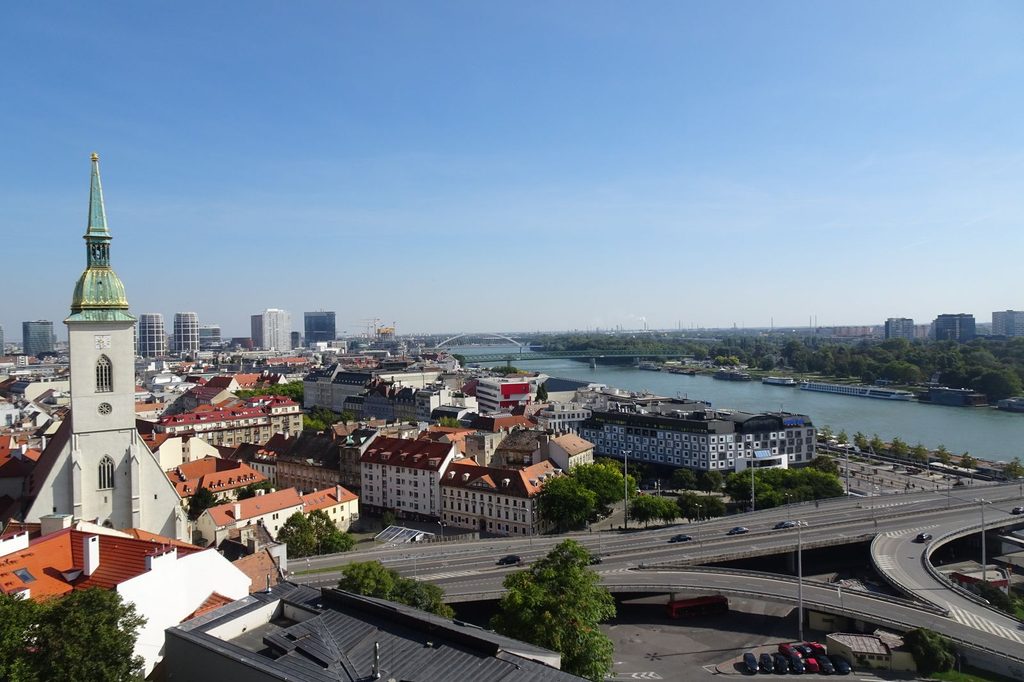
When booking, most people look at the map and hunt for a spot as close to the Main Square as possible, yet Bratislava is far too small for that to be a sensible criterion. The whole historic core can be walked in half an hour, and from most city districts you reach the centre faster than you would cover two stops in another city. The difference between the centre and the outskirts is therefore not about what you manage to see, but about how much parking will cost you, how well you sleep and whether you can get back to the flat during the day. This article breaks it down by four criteria and turns them into a decision table at the end.
Article contents
What Actually Decides It
Once you break the question “centre or outskirts” into pieces, four things remain that can be answered before you even book. Everything else, meaning the view, the neighbourhood or the impression from the photos, comes second, because it neither ruins nor saves a stay.
- 🚗 Are you arriving by car? If so, location stops being a question of distance and becomes a question of parking, since regulated zones apply in the centre while on the outskirts there is usually a space by the house.
- 🗓️ How many nights are you staying? With one or two nights every journey counts double, whereas on a week-long stay an extra ten minutes dissolves into the programme.
- 🌙 How lightly do you sleep? A street with bars and a street in a residential zone are two different worlds at night, and that applies above all from Friday to Sunday.
- 🔁 Will you be coming back during the day? With children, with a laptop or in a heatwave it pays to stay somewhere that does not turn an afternoon break into a whole expedition.
If you answer these four questions honestly, the rest of the article only fills in the numbers. The first two criteria are measurable, so they can be settled with no guesswork at all.
Travel Time: What You Buy With Location
Bratislava has the advantage that distances are short and public transport runs across the city without changes. From districts such as Ružinov, Petržalka or Dúbravka you reach the centre on a single connection, so the real time lost is around a quarter of an hour each way. If you return to your accommodation twice a day, that means roughly an extra hour a day, and that is a number worth reckoning with.
On a short visit this number carries the most weight. When you come for two nights, an hour a day is about a tenth of your waking time in the city, while on a week-long stay it is a difference you will not even notice. That is exactly why the centre makes the most sense for a weekend without a car and the least sense for a longer stay with the car parked outside the house.
What Travelling by Public Transport Costs
If you are going to commute from the outskirts, it pays to know in advance what you will spend on tickets. In zones 100 and 101, meaning within Bratislava, these basic prices have applied since 1 July 2026:[1]
| Ticket | Paper | Electronic |
|---|---|---|
| 30 minutes | EUR 1.20 | EUR 1.09 |
| 60 minutes | EUR 1.80 | EUR 1.60 |
| 24 hours | EUR 5.40 | EUR 4.85 |
| 72 hours | EUR 10.70 | EUR 9.68 |
Children under six travel free and children from six to seventeen are entitled to half fare.[1] A couple commuting from the outskirts will therefore spend roughly twenty euros on tickets over a three-day stay, a sum worth comparing with parking in the next section. Lines, changes and the journey from the airport are covered in more detail in our article on transport in Bratislava. Check the prices before you travel, as the tariff changes from time to time.
Plan ahead for the journey home in the evening, since once the daytime lines finish, night services run at longer intervals. You will get from the centre to the outskirts after midnight, but you may well wait twenty minutes at the stop.
Parking: The Biggest Difference in Money
This is the point where the centre and the outskirts diverge the most, and also the one people most often overlook when booking. Bratislava has a regulated parking system called PAAS and the hourly rate for a visitor follows the tariff band the zone belongs to.[2]
| Tariff band | Price per hour | Roughly where it applies |
|---|---|---|
| A | EUR 2.00 | the historic centre, the area around the castle, the busiest streets |
| B | EUR 1.50 | the wider centre |
| C | EUR 1.00 | transitional and residential areas |
| D | EUR 0.50 | outlying zones |
Band A covers precisely the streets most guests head for, so a car left on the street in the centre racks up two euros for every chargeable hour. The charging times are set separately for each zone, so always check them on the traffic sign at the entrance to the zone and on the zone map at paas.sk.[2] How payment works, where the park and ride sites are and what to do on a longer stay are covered in our article on parking in Bratislava.
On the edge of the city the situation is simpler, because in residential districts and in villages beyond the city boundary parking by the house tends to be part of the accommodation. The difference over a weekend easily climbs into the tens of euros, and on a week-long stay it adds up to more than the difference in the price of the accommodation itself. There is one exception worth asking about, though: even in the centre there are flats with their own garage, and those combine a location in the heart of the city with no charge for parking.
Noise and Night-Time Quiet
Night-time noise is the reason some guests with the same budget keep choosing the outskirts, even though they could comfortably afford the centre. In the core of Bratislava the bars, terraces and deliveries are concentrated in a small area, so at the weekend street noise reaches even the upper floors. A residential district with a lawn under the windows does not have that problem, and you notice the difference on the very first night.
This is not just an impression. A German study from 2025, published in the International Journal of Environmental Research and Public Health, reanalysed extensive survey data split by whether people live in the countryside, in the suburbs or in the inner city.[3] The authors found that road noise annoys people at noticeably lower levels than the World Health Organization recommendations assume: ten percent of highly annoyed people showed up as early as 35 dB Lden, while the recommendations work with 53 dB.[3] In other words, the threshold at which noise starts to bother us is usually lower than we admit when booking.
That leads to a practical recommendation. If you sleep lightly and still want to stay in the centre, look for a flat facing the courtyard or a side street and avoid being next door to a night venue. If you are not sure, the edge of the city is the safer choice, because there quiet is the default state rather than a lucky coincidence.
Decision Table by Type of Stay
The table below combines the four criteria into specific situations. Find the row that fits your stay best and you have your answer without looking any further.
| Type of stay | Recommendation | Why |
|---|---|---|
| A weekend without a car, a first visit | Centre | You can walk to the sights and on two nights the time saved is worth the most. |
| Arriving by car for several days | Outskirts or the centre with a garage | Parking in band A adds up to tens of euros over several days. |
| A stay with small children | Outskirts | A quiet night, greenery by the house and a space for the car count for more than walking distance. |
| A business trip with a meeting in the centre | Centre | No working out changes in the morning and you can go back to the flat for lunch. |
| A stay of a week or more | Outskirts | On a longer stay the daily time lost dissolves, while the savings grow. |
| Trips around the region and into Austria | Outskirts | From the outskirts you reach the motorway faster and avoid fighting through the centre. |
| A night out and getting back after midnight | Centre | No waiting for a night connection and no taxi fare. |
If two different answers fit at once, for example a business trip by car, lean towards parking. It is the only criterion that can be put into euros in advance, while the rest is about comfort. Our overview of how much a stay in Bratislava costs also helps with planning the budget.
How It Looks Across Our Apartments
Our own offer shows the difference nicely, because we have flats in both locations. In the heart of the city, CASTE stands on Zámocká Street, a few minutes' walk from Bratislava Castle and the Presidential Palace, and it has its own garage in the basement of the building, free for guests. It is exactly the case mentioned above, where a location in the centre does not come hand in hand with a parking charge.
On the edge of the city we have more options and each one solves a slightly different situation. BAGRA and LUCAO sit in the quieter parts of Dúbravka with free parking by the house, FIAOR stands in a calm part of Petržalka roughly seven kilometres from the centre and BRIS on Prístavná is about four kilometres out, with a private reserved parking space in front of the building. SADBA on Ivánska cesta has parking in a guarded compound behind a barrier, which you will appreciate before an early flight, and ROVAO in Rovinka goes a little further still, offering village quiet and a space in the underground garage.
What they have in common is that parking is included in the price of the stay and entry is handled by self check-in, so a late arrival is not a problem even on the edge of the city. When comparing specific neighbourhoods, our article on the best locations for accommodation in Bratislava helps, as it describes the individual districts in more detail. Current availability and the price for your dates are in the calendar on each apartment page.
Frequently Asked Questions (FAQ)
Is it better to stay in the centre of Bratislava or on the outskirts?
What decides it is how you will get around the city and how much time you will spend in your accommodation. If you arrive without a car for two days and want to walk everywhere, the centre will save you hours of travelling. If you come by car, stay longer or want to rest at night, the edge of the city tends to be more practical, because parking is usually by the house and residential districts are quiet.
How much does parking in the centre of Bratislava cost a visitor?
The hourly rate for a non-resident follows the tariff band of the PAAS zone: band A costs EUR 2.00 per hour, band B EUR 1.50, band C EUR 1.00 and band D EUR 0.50. Band A covers the historic centre and the area around the castle. The charging times differ from zone to zone, so check them on the traffic sign at the entrance and on the zone map at paas.sk.
How much does a public transport ticket in Bratislava cost?
In zones 100 and 101, meaning within the city, a paper 30-minute ticket has cost EUR 1.20 and a 60-minute ticket EUR 1.80 since 1 July 2026. The electronic ticket is cheaper, at EUR 1.09 and EUR 1.60. On a longer stay a 24-hour ticket often pays off, at EUR 5.40 on paper or EUR 4.85 electronically. Children under 6 travel free. Check the prices before you travel, as the tariff can change.
Is the centre of Bratislava noisy at night?
It depends on the particular street, but around bars and busy routes the weekend noise tends to be markedly higher than in a residential district. A German study from 2025, which compared the countryside, the suburbs and the inner city, found that road noise annoys people at lower levels than international recommendations assume. If you sleep lightly, choose a flat facing the courtyard or accommodation outside the night-time zone.
How far from the centre of Bratislava is it still sensible to stay?
The practical limit tends to be about 20 minutes into the centre on a single connection or by car, because then you can drop by your accommodation during the day as well. Districts such as Ružinov, Petržalka or Dúbravka fall within that range and have direct lines to the centre. In a village beyond the city boundary, count on depending on regional services without a car, and plan the evening journey back in advance.
Conclusion
The centre of Bratislava sells time and atmosphere, the outskirts sell quiet and parking, and neither choice is objectively better. If you answer the four questions from the opening before you book, the decision narrows down to one row in the table above and the rest is just a matter of confirming the dates. Take a look at all 8 apartments and pick the location that fits your own stay.
Sources
- IDS BK tickets valid from 1 July 2026 (zones 100 and 101, paper and electronic tickets, free travel for children). imhd.sk (verified October 2026).
- PAAS, the Bratislava parking assistant: tariff bands and hourly rates for non-residents, details of the charging times by zone. paas.sk/nie-som-rezident (verified October 2026).
- Benz, S., Kuhlmann, J., Bilik, J., Liepert, M., & Schreckenberg, D. (2025). Noise Annoyance and Sleep Disturbance Due to Road Traffic and Railway Noise in Germany. International Journal of Environmental Research and Public Health, 22(9), 1366. doi.org/10.3390/ijerph22091366.
- Dopravný podnik Bratislava: how to travel, ticket validity and night lines. dpb.sk.
Ticket prices and parking rates can change, so check them before you travel on the official websites of the transport operator and the city.