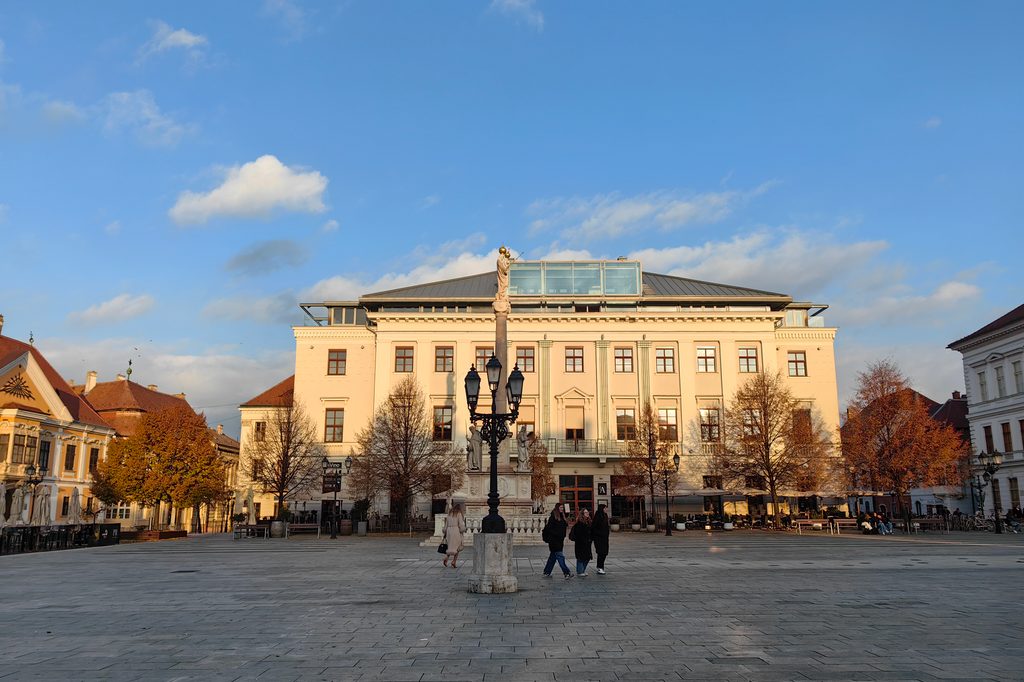
If you already have Devín, Vienna and Komárno behind you, Győr is the logical next step. It sits about 80 km from Bratislava on the M1 motorway towards Budapest and offers three things that are hard to find together anywhere else: a compact baroque centre you can cover entirely on foot, a large water and thermal complex, and a handful of family attractions on top. This article is a practical guide: how long it takes, what it costs in forints, where to park and in what order to put it all together so that you fit in both the town and the water.
Article contents
How to Get from Bratislava to Győr
The road distance is roughly 80 km, so the journey itself is not something that eats up the day. The difference between the options is less about time and more about where you end up and whether you have to change.
| Option | Time | Indicative price | What to keep in mind |
|---|---|---|---|
| Train with a change in Hegyeshalom | about 1 h 25 min | depends on the fare, check the timetable | The change is only a few minutes, a delay can break it |
| Train via Parndorf in Austria | about 1 h 55 min | depends on the fare, check the timetable | A more comfortable change, departure from Petržalka |
| Bus with FlixBus | about 1 h | from EUR 7.98 (dynamic pricing) | No change, the stop is right by the centre |
| Car via Rajka, the M15 and the M1 | about 1 h | fuel plus a motorway vignette | You need an e-vignette and the centre has paid parking |
By train: there is no direct service
This is the most common misunderstanding. No direct train runs from Bratislava to Győr, even though the two towns are only an hour apart. The quickest connection goes from Bratislava-Nové Mesto to the border town of Hegyeshalom, where you change onto an international train heading for Budapest and reach Győr in under half an hour. According to the timetable the whole trip works out at roughly an hour and a half. The second option leaves from Bratislava-Petržalka and runs via Parndorf in Austria; it takes about half an hour longer, but the change is more comfortable.[8]
The return journey works the same way in reverse: early-evening trains from Győr bring you back to Bratislava via Hegyeshalom within two hours, so you can comfortably stay in town until the evening. One important note for 2026: because of the construction of the southern railway ring in Budapest (Déli Körvasút), train timetables in Győr changed from the end of August, as the city portal gyor.hu also reported.[9] So always look up times afresh rather than relying on an older search.
By bus: the simplest option without a car
If you would rather not deal with changes, the bus is the most straightforward choice. FlixBus quotes a journey time of about one hour on the Bratislava to Győr route, fares from EUR 7.98 and at least four services a day, with the first departure from Bratislava at 04:50 and the last at 21:00. In Bratislava you can board at several points, including the Nivy bus station and the stop by the SNP Bridge; in Győr you get off at the bus terminal on Hunyadi Street, a few minutes' walk from the historic centre.[7] Prices are dynamic, so booking early pays off.
By car: mind the vignette
By car you cross the border at Rajka and then take the M15 and M1 motorway sections. For those stretches you need a Hungarian electronic motorway vignette, which you buy in advance online on the official portal or at petrol stations near the border.[10] Check the current price and the correct vehicle category there, as rates change from year to year. If you would rather skip the vignette, you can take the parallel main road number 1 via Mosonmagyaróvár, though the drive is noticeably slower. The same logic applies as on other day trips: if you plan to leave the car in Bratislava and travel by public transport, it is worth choosing accommodation with parking included.
The Baroque Centre: What to See on Foot
Győr is nicknamed the town of rivers, because this is where the Rába meets the Mosoni-Duna, a branch of the Danube. The historic core is small and you can walk all of it in two to three hours. The official city tourism portal Hellogyőr sums up these stops in its top ten recommendations.[1]
- 🏛️ The town hall (Városháza): a monumental neo-baroque palace from the end of the 19th century. In front of it stands a cross topped with an iron rooster, the symbol of the town, erected for the 750th anniversary of Győr gaining the status of a royal free town.
- ⛪ The Benedictine complex on Széchenyi Square: a church, a monastery and a grammar school. The Church of St Ignatius of Loyola was completed by the Jesuits in the mid-17th century and is the oldest baroque church in present-day Hungary. After the Jesuit order was dissolved, the Benedictines took it over at the start of the 19th century and still teach here today.
- 🎨 The Esterházy Palace: created by gradually joining five houses in the 18th and 19th centuries. Notice the enclosed corner balcony, a local architectural speciality of which there are several dozen in the centre. Today the palace houses the Rómer Flóris Museum.
- 🐓 The iron rooster on Dunakapu tér: a reminder of the town's liberation from Turkish rule. Legend has it that the Turks put the rooster up in 1594 and declared they would stay until it crowed. Four years later the town fell. Today a copy of it stands guard on an ornamental fountain in the square.
- 💧 The Jedlik spring: a memorial to Ányos Jedlik, the Benedictine monk who invented the soda siphon. The turquoise sculpture weighs 365 kg and is the work of local glass artist László Hefter.
- 🌉 The riverside promenades and Radó Island: the loveliest route runs from Dunakapu tér around Chapter Hill (Káptalandomb) beneath the ramparts to Bécsi kapu tér, and from there across the bridge to shady Radó Island between the two arms of the Rába.
The cathedral and its three treasures
Chapter Hill above the rivers is the spiritual heart of the town. The Cathedral of the Assumption of the Virgin Mary already stood here in the 11th century and took on its definitive baroque form in the 18th. It holds three notable relics: the Herm of St Ladislaus, a Gothic reliquary more than 600 years old containing part of the skull of King Ladislaus I, which along with the Holy Crown and the Holy Right Hand ranks among Hungary's three most important sacral treasures; the painting of the Weeping Madonna, brought here from Ireland in the 17th century; and the marble sarcophagus of the martyr bishop Blessed Vilmos Apor, who saved many lives at the end of the Second World War.[1]
The view from the Bishop's Castle
Directly opposite the cathedral stands the Bishop's Castle with its lookout tower (Püspökvár), the only prelate's residence of medieval origin in Hungary and still the working seat of the Győr diocese. From the top of the square, truncated tower you can see the centre, Radó Island and the point where the rivers meet. If you enjoy views from above in Bratislava, this is the Győr equivalent, and it is the best way to get your bearings at the start of a walk.
The Carmelite church
On Bécsi kapu tér you will find the Carmelite church from the first half of the 18th century, unusual in its construction: it has an oval floor plan and a free-standing tower. Older still is the Loreto Chapel, entered from the confessional corridor, a copy of the Holy House in Nazareth which, together with its statue of the Black Madonna, is an important stop for pilgrims.[1]
The RQ Thermal Baths and Sauna World
This is the reason people come to Győr even in November. The RQ Vízi Élménypark és Gyógyfürdő complex, which many Slovaks still know under its older name Rába Quelle, covers 4.5 hectares with 21 pools and 11 food and drink outlets according to the operator, plus a two-level Japanese-style sauna world with a capacity of 150 people.[2] In other words, it is a water park with slides and a classic thermal spa in one.
| Ticket (valid from 20 June 2026) | Price in Ft | Approx. in EUR |
|---|---|---|
| Adult, whole complex except the sauna world | 8,900 Ft | EUR 24.50 |
| Under 18s and pensioners | 6,800 Ft | EUR 18.70 |
| Family (2 adults + 1 child under 18) | 17,900 Ft | EUR 49.30 |
| Each additional child under 18 | 5,000 Ft | EUR 13.80 |
| Child under 3 (registration ticket) | 800 Ft | EUR 2.20 |
| Sauna world (added to a ticket) | 2,500 Ft | EUR 6.90 |
| Sauna sheet rental (1 pc) | 700 Ft | EUR 1.90 |
| Locker / sun lounger | 1,000 Ft / 2,500 Ft | EUR 2.80 / EUR 6.90 |
The conversion into euros is indicative only, based on the European Central Bank reference rate of 362.78 HUF to EUR 1 on 21 August 2026.[6] Check prices and opening hours on the baths website before your visit.
Opening hours and three things that catch people out
The thermal and adventure sections as well as the outdoor pool area are open daily from 9:00 to 20:00 according to the official schedule, and so is the children's section. The operator asks visitors to leave the pools 15 minutes before closing.[3] Three things are worth knowing in advance:
- The sauna world is not open every day. The schedule shows it operating only on Friday, Saturday and Sunday from 15:00 to 20:00; from Monday to Thursday it is closed. If saunas are your reason for going, plan a weekend.
- The swimming pool (uszoda) has been closed since 4 July 2026. If you want to swim lengths, check the situation beforehand, as lane training is not available here at the moment.
- Saunas are used without swimwear. The operator states explicitly that part of the sauna area is textilmentes (textile-free) and you enter the heat cabins uncovered, with only a sauna sheet, which you can rent on site.
If the idea of thermal water grows on you enough that you want more of it after you return, take a look at our overview of wellness and saunas in Bratislava. And one more realistic expectation: the quality of Hungarian spas varies across the country. A 2025 study published in Worldwide Hospitality and Tourism Themes, which combined statistics with an expert Delphi survey, points out that the Hungarian thermal spa sector needs investment in infrastructure, better targeted products for specific guest segments and a solution to the shortage of trained staff.[11] In practice that means: do not expect the same standard everywhere, and with larger complexes such as RQ it is better to read in advance exactly what is included in the price.
Győr with Kids: The Zoo and Mobilis
Thanks to its combination of water and indoor attractions, Győr is a rewarding destination with children, but you do need to check the opening days or you can come unstuck.
The zoo in Kiskútliget
Győr Zoo is located in the Kiskútliget district and even has a Slovak version of its website, which makes planning pleasant. Opening hours change with the season: from 1 April to 30 September 10:00 to 19:00, in March and October 10:00 to 18:00, and in the winter months from November to the end of February even 10:00 to 21:00. Watch out for one rule people often miss: the ticket office and last entry close an hour before closing time, and the animal houses start shutting an hour early as well.[4] Check current admission prices on the zoo website.
Mobilis: an interactive science centre
Mobilis is a hands-on science and technology centre with an interactive exhibition, a robotics area, a simulator, virtual reality and an escape room. It sits on Vásárhelyi Street next to the university.
- 🕐 Open only Tuesday to Friday, 10:00 to 17:00. It is closed on Monday, Saturday and Sunday, so Mobilis does not work for a classic weekend trip.
- 🎟️ Admission: adult 5,000 Ft (about EUR 13.80), child, student, teacher or pensioner 3,700 Ft (EUR 10.20), family ticket for two adults and two children 16,000 Ft (EUR 44.10). Children under 4 enter free.
- ➕ Add-on experiences: a ride on the simulator or 15 minutes in virtual reality for 2,450 Ft each (EUR 6.80), the escape room 7,300 Ft (EUR 20.10) per session, with a recommended group size of 4 to 5 people.[5]
If you are heading out with children and want to test shorter routes first, a good warm-up is our article on Bratislava with kids and our overview of other day trips from Bratislava.
Parking, Payments and Forints
If you arrive by car, parking is the one thing that can complicate the trip unnecessarily. According to the municipal company Győr-Szol, the centre of Győr has three paid zones graded outwards from the core, plus two special areas.[12]
| Zone | Price per hour | Approx. in EUR | Max. stay |
|---|---|---|---|
| Zone I (red, closest to the core) | 520 Ft | EUR 1.43 | 2 hours |
| Zone II (blue) | 440 Ft | EUR 1.21 | 3 hours |
| Zone III (yellow) | 320 Ft | EUR 0.88 | no limit |
| Dr. Petz car park | 200 Ft, first hour free, 24 h for 600 Ft | EUR 0.55, all day EUR 1.65 | no limit |
| Car park by the baths (Fürdőtér) | 320 Ft | EUR 0.88 | no limit |
The best tip for a full day in town is clearly the Dr. Petz car park: the first hour is free and a full 24 hours costs 600 Ft, so around EUR 1.65. For the same money in zone I you would last a little over an hour. You can also park free of charge under Petőfi Bridge (roughly 160 spaces) and on the temporary car park behind the Győr Plaza shopping centre (roughly 220 spaces).[12]
When you pay matters just as much. The machines operate on weekdays from 8:00 to 18:00, in zone I on Friday and Saturday until 20:00, and in zone II on Saturday from 8:00 to 14:00. Outside those hours parking is free. One more note if you drive to the baths: since 1 October 2024 the Fürdőtér car park has no longer been run by the baths; the municipal rate of 320 Ft per hour applies there and the former discounts for bathers have ended.[2]
Payments: where you need coins and where you need a card
In Hungary you pay in forints, but in practice the question is not how much cash to bring but where each payment method is mandatory:
- Parking machines take coins of 10, 20, 50, 100 and 200 Ft, and only the newer ones accept contactless cards. The centre also has machines that issue a ticket only after you enter your registration number, so keep it to hand.[12]
- At the RQ baths it is the other way round: inside the complex and at the food outlets you pay only by bank card or with a rechargeable spa wristband, and cash is not accepted.[2]
The practical conclusion: a few coins for parking come in handy, but the main wallet for this trip is your card.
A Plan for One Day
This order works best, because it puts culture in the morning when you still have energy and water in the afternoon when you no longer feel like walking. The times are indicative and follow real services from the timetable.
- 08:30 departure from Bratislava by train or on the morning bus. You arrive in Győr around 10:00.
- 10:00 to 10:30 Széchenyi Square. Coffee on the square, the Benedictine church, the Esterházy Palace and the corner balconies.
- 10:30 to 12:00 Chapter Hill. The cathedral with the Herm of St Ladislaus and the climb up the lookout tower of the Bishop's Castle to see the confluence of the rivers from above.
- 12:00 to 13:00 lunch and Dunakapu tér. The iron rooster, the waterfront and, if you fancy it, a detour to Radó Island.
- 13:00 to 14:00 Bécsi kapu tér. The Carmelite church and the Loreto Chapel, then a walk beneath the ramparts.
- 14:00 to 18:30 the RQ baths. Four hours is a sensible minimum for 21 pools. If it is Friday to Sunday, add the sauna world.
- 18:45 heading home. Early-evening trains bring you back to Bratislava via Hegyeshalom within two hours, and buses still leave Győr in the evening.
If you also want to fit in the zoo or Mobilis, one day is not enough and you need to split it: culture and the baths on day one, family attractions on day two. In that case it makes sense to build Győr into a longer plan, for example as one of the days in a long weekend in Bratislava, or to combine it with other cross-border trips such as Komárno or Vienna.
Extending the Trip: Pannonhalma
If you have a car and feel like adding one more stop, the Pannonhalma Archabbey lies about 21 km from Győr, just under half an hour's drive. According to the abbey, Grand Prince Géza settled Benedictine monks here as early as 996, and the monastery itself was founded by his son, St Stephen. The abbey and its natural surroundings have been a UNESCO World Heritage Site since 1996.[14] In good visibility you can even see it from the tower of Győr town hall, according to the city portal.[1]
When planning, allow for three things the abbey lists on its website:[13]
- Seasonal hours. From 1 June to 30 August the monastery is open daily from 9:00 to 18:00; from 31 August to 31 October it is open Tuesday to Saturday from 9:00 to 17:00 and closed on Monday and Sunday.
- Buy tickets with time to spare. The ticket office closes at the latest one hour before the end of visiting time.
- Dress code. The abbey asks for clothing appropriate to a sacred space, meaning covered shoulders and trousers or a skirt at least below the knee. During festivals and events the visiting regime also changes, so check your date.
Frequently Asked Questions (FAQ)
How do I get from Bratislava to Győr without a car?
There is no direct train, so you always change once. The fastest option runs via Hegyeshalom, where you switch from a regional train to a service heading for Budapest; the whole journey takes about an hour and a half. The second option goes via Parndorf in Austria and takes slightly longer. By FlixBus the carrier quotes roughly one hour, with several departures from Bratislava every day. Always check current times in the timetable, because a short delay is enough to break the connection at the change.
How much does admission to the RQ thermal baths in Győr cost?
According to the price list valid from 20 June 2026, a basic all-day adult ticket costs 8,900 Ft, a ticket for anyone under 18 and for pensioners 6,800 Ft, and a family ticket for two adults with one child 17,900 Ft. Access to the sauna world is bought on top of a regular ticket for 2,500 Ft. Prices can change, so check them on the baths website before your visit.
Where can I park in Győr and how much does it cost?
The centre has three paid zones: in the first you pay 520 Ft per hour with a maximum stay of two hours, in the second 440 Ft per hour and in the third 320 Ft per hour with no time limit. The best value is the Dr. Petz car park, where the first hour is free and a full 24 hours costs 600 Ft. You can also park free of charge under Petőfi Bridge and behind the Győr Plaza shopping centre. Outside the machines' operating hours parking is free.
Is Győr a good trip with children?
Yes, the town has three strong family draws: the RQ water adventure park and thermal baths with slides and children's pools, the zoo in the Kiskútliget district and the interactive science centre Mobilis. Watch out for one thing: Mobilis is only open from Tuesday to Friday and is closed on Saturday, Sunday and Monday, so do not plan it for a weekend trip.
Do I need a motorway vignette and cash in forints in Hungary?
If you drive along the M15 and M1 motorway sections, you need a Hungarian electronic motorway vignette, which you buy in advance on the official portal or at petrol stations near the border. Without a vignette you can use the parallel main road number 1, but the journey is slower. Payment is in forints and cards are accepted almost everywhere: inside the RQ baths complex they in fact take only cards or rechargeable spa wristbandes, not cash. Parking machines, on the other hand, take coins from 10 to 200 Ft and only the newer ones accept contactless cards.
Conclusion
Győr is the kind of trip that is hard to get wrong. It is close enough for you to be back in Bratislava for the night, small enough to cover the centre on foot, and well equipped enough for you to spend a whole day in thermal water. Remember three things and you will be ahead of most visitors: there is no direct train and you have to change, the RQ sauna world runs only from Friday to Sunday, and the Dr. Petz car park costs 600 Ft for the whole day. The rest is simply a matter of how much of an appetite you have for baroque and for water.
If you want to keep Bratislava as a base for more trips like this, apartments with parking included and self check-in make a good starting point, for example SADBA on Ivánska cesta near the road out towards Hungary, or BAGRA on Bagarova Street. Our overview of the best locations for accommodation in Bratislava can help you choose too.
Sources
- Hellogyőr, the official tourism portal of the city of Győr: TOP10 látnivaló (sights, history, the cathedral, the Bishop's Castle, the Carmelite church). hellogyor.hu/latnivalok/top10 (accessed 24 August 2026).
- RQ Vízi Élménypark és Gyógyfürdő Győr: price list valid from 20 June 2026, payment conditions inside the complex and information on the Fürdőtér car park tariff. rabaquelle.hu/arak.
- RQ Vízi Élménypark és Gyógyfürdő Győr: opening hours valid from 20 June 2026 (thermal area, saunas, children's section, swimming pool). rabaquelle.hu/nyitvatartas.
- Győr Zoo (Kiskútliget): seasonal opening hours, ticket office closing and last entry. zoogyor.com.
- Mobilis Interaktív Élményközpont Győr: admission and add-on tickets, opening hours. mobilis-gyor.hu/jegyar.
- European Central Bank: euro reference rate, EUR/HUF 362.78 as at 21 August 2026. ecb.europa.eu.
- FlixBus: the Bratislava to Győr route, journey time, fares from EUR 7.98, number of services and stops. flixbus.sk.
- CP.sk (INPROP): train connection search for Bratislava to Győr, including changes in Hegyeshalom and Parndorf. cp.sk.
- Győr Megyei Jogú Város: information on the change to the timetables of Győr and Sopron trains from the end of August 2026 in connection with the Déli Körvasút construction. gyor.hu.
- Nemzeti Útdíjfizetési Szolgáltató: the official portal for buying the Hungarian electronic motorway vignette and an overview of valid tariffs. nemzetiutdij.hu.
- Smith, M. K. (2025). Health tourism in Hungary: future challenges for thermal spas. Worldwide Hospitality and Tourism Themes, 17(2), 187–199. doi.org/10.1108/whatt-01-2025-0027.
- Győr-Szol Zrt.: felszíni fizetőparkoló hálózat (zone tariffs, operating hours, payment methods, free car parks). gyorszol.hu.
- Pannonhalmi Főapátság: opening hours by season, entry rules and recommended dress. turizmus.pannonhalmifoapatsag.hu.
- Pannonhalmi Főapátság: the history of the abbey (monks settled here in 996) and its inscription on the UNESCO World Heritage List in 1996. turizmus.pannonhalmifoapatsag.hu/rolunk.
Admission prices, opening hours, parking tariffs and timetables can change, and the forint exchange rate moves daily. Check everything before your visit on the website of the specific place or carrier.