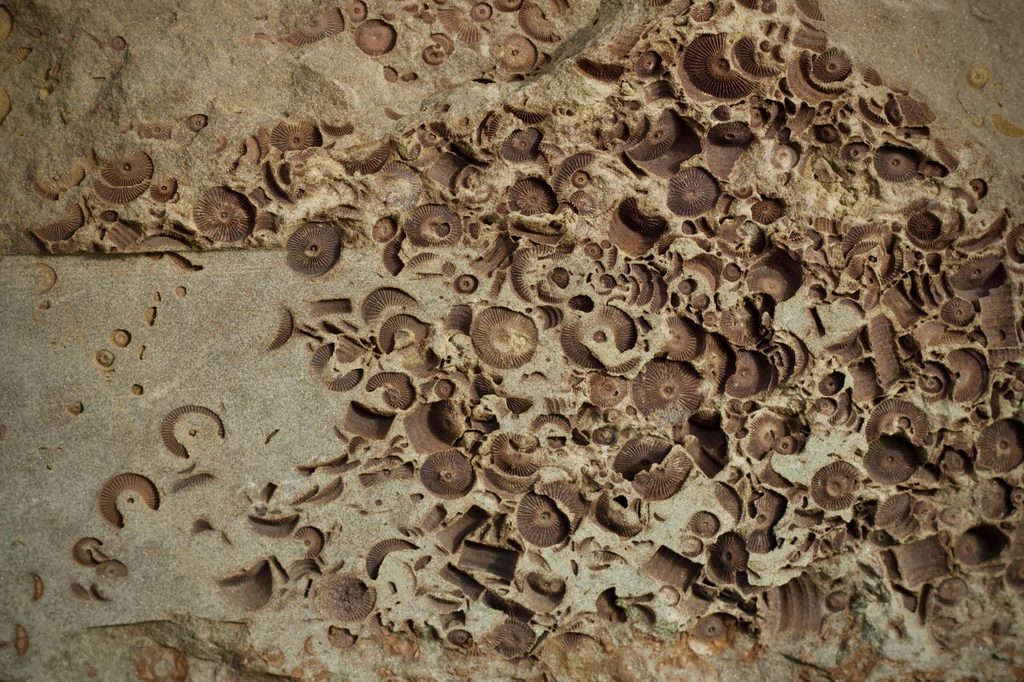
Sandberg is probably the only place in Bratislava where you can touch the bottom of a sea. The sandstone cliff above Devínska Nová Ves is what remains of the Miocene sea that once reached this far, and it ranks among the best-known palaeontological sites in Central Europe. Yet it is a half-day trip that starts at a city bus stop and costs next to nothing. This article is a practical guide: what you will see at Sandberg, how to get there, where the nature trail across Devínska Kobyla leads, which rules apply and when it makes sense to come.
Article contents
Why Sandberg Is Special
The pale sandstone cliff, which looks like a piece of desert spilled by mistake into a deciduous forest, is the remnant of a sea floor. Geologists place the sediments in the Upper Badenian, a stage of the Middle Miocene, meaning they are more than ten million years old.[5] Back then the sea reached this far, and the sand it left behind preserved whatever lived in it.
The borough's official website states that around 300 fossil species have been found at the site: gastropods, bivalves, sea urchins, shark teeth, and remains of turtles and seals.[1] The palaeontological localities database of Comenius University adds rays, bony fish, crocodiles, sirenians, dolphins and whales.[5] In other words, an entire marine ecosystem is written into this cliff, not a single chance find.
Sandberg is not only about palaeontology, though. The cliff faces south, warms up quickly and creates conditions found nowhere else in Bratislava. That is exactly why the European bee-eater nests here, a colourful bird that digs burrows up to a metre deep into the sand.[1] And thirdly, there is the view from here over the Morava river floodplain, towards Devín Castle and across to the Austrian side.[1]
The practical upshot: one short route gives you geology, birdwatching and a viewpoint. That is why school groups come here, and so do people who have never spent more than an hour in nature in Bratislava.
How to Get to Sandberg
The best news about this trip is that you can do it entirely without a car. Right below the site there is a public transport stop called Pri Sandbergu, served by bus lines 21 and 29.[6] Line 21 connects Devínska Nová Ves with the main bus station; line 29 runs through Devín and below the castle.
| Option | How it works | Who it suits |
|---|---|---|
| Bus 21 | From the main bus station towards Devínska Nová Ves, get off at the Pri Sandbergu stop. | Most visitors. The shortest way straight to the site. |
| Bus 29 | The line runs through Devín and past Devín Castle, so you can combine the castle and Sandberg in one day. | Anyone who wants to add the castle at the confluence of the Danube and the Morava to the fossils. |
| On foot along the trail | The nature trail starts in Devín on Hadia cesta and ends at Sandberg, so you can also arrive from above. | Hikers who want the whole reserve, not just the cliff. |
| By bike | Devínska Nová Ves is linked to the cycle routes along the Morava and the Danube. Inside the reserve you may ride only on the routes designated for it.[3] | Cyclists; you'll find more loops in our article Cycling Routes in Bratislava. |
You can drive as far as Devínska Nová Ves, but no road leads to the cliff itself and you will walk the last stretch along a hiking trail. Given that public transport stops right by the site, a car is more of a complication. Check timetables and ticket prices before you travel, as buses run differently at weekends than on weekdays.
The Nature Trail Across Devínska Kobyla
Sandberg is also the gateway to the reserve: the first board of the nature trail stands here.[1] The trail is easy and can be walked in either direction.
| Length | 4 km |
| Elevation gain | approx. 170 m |
| Stops | 5 information boards |
| Walking time | around 2 hours |
| Type | linear, both directions, walking, year-round |
| Start and finish | Devín, Hadia cesta → Devínska Nová Ves, Sandberg |
| Markings | blue, later yellow hiking markers |
The figures come from the database of Slovak nature trails.[2] Because the trail is linear, that is, it does not end where it started, it pays to plan it one way and take the bus back. A practical combination: line 29 to Devín, see the castle, then climb up to Hadia cesta and follow the trail down to Sandberg, from where line 21 or 29 takes you home.
The reserve has a second side that gets talked about less. Around 600 species of vascular plants grow here, more than twenty of them protected, and a similar number of butterfly species live here.[7] For such a small area right next to a housing estate, that is a remarkable figure.
The Lookout Tower on the Highest Hill in Bratislava
At 514 metres above sea level, Devínska Kobyla is the highest hill in Bratislava, and since 2020 a lookout tower has stood on it. It was built by the Bratislava-Devínska Nová Ves borough to a design by the Šebo Lichý architecture studio. The tower is 21.26 metres tall, weighs 23.4 tonnes and 112 steps lead to the top.[4]
Entry is free of charge. Several marked routes lead to the tower: the green trail from Devínska Nová Ves, the yellow from Dúbravka, the blue from Dlhé diely and the red from Devín Castle.[4] That means you can tailor the climb to where you are staying, without crossing the whole city.
From the platforms you can see Bratislava, the Little Carpathians and a slice of Austria and Hungary. If views are your thing, we compare the city's individual viewpoints in the article Bratislava Viewpoints: The Best Views over the City. Devínska Kobyla is the most natural of them: there is no lift and no road up to the tower, you have to walk.
Reserve Rules: What Is and Isn't Allowed
This is the part most articles about Sandberg leave out, even though it has changed in recent years. The area has been protected since 1964, but on 1 January 2024 government regulation no. 375/2023 came into force, declaring the Devínska Kobyla Nature Reserve with an area of 651.56 hectares. It is divided into two zones: zone A, covering 489.18 ha, has the fifth level of protection, and zone B, covering 162.38 ha, the fourth level.[8] The fifth level is the strictest regime Slovak nature protection law recognises.
To keep the area open to visitors, the Bratislava District Office published a list of designated places, that is, specific routes and areas where some of the bans are lifted. It covers movement off the trails, cycling on defined routes, skiing on snow, lighting fires at existing fire pits, and picking plants and mushrooms within a hundred-metre strip along the nature and hiking trails.[3]
For the ordinary visitor, three things follow from this:
- Stay on the marked trails. Shortcuts down the slope are not just a matter of courtesy, they are a matter of the protection regime.
- Leave the fossils where they are. Digging them out loosens the cliff and speeds up its erosion. Whatever you take away will no longer be there for anyone else.
- Bikes and fires only where the list allows. Check the current wording before your visit, as the rules can change.
It sounds strict, but it is the reason there is still something to see here. Sandberg is an exposed cliff that crumbles naturally, and every extra intervention takes something away from it.
When to Go and What to Bring
The trail is open all year and Sandberg can be visited in any season, but the differences are noticeable.
- Spring (April to June) is the best time. The slopes are in bloom, butterflies are on the move and the bee-eaters return to nest. It isn't hot yet, either.
- Summer is demanding on the shadeless cliff, where the sand heats up. Go early in the morning or towards evening and bring water, as there are no shops or refreshment stands along the route.
- Autumn offers the best visibility from the lookout tower and pleasant temperatures for the climb.
- Winter is quiet and empty, but after rain or frost the trail tends to be slippery. Count on sturdy shoes.
With children, the shorter option works well: take the bus right below Sandberg, look at the cliff and the boards, and head back. Kids are usually captivated by the idea that sharks once swam where they are standing. You'll find more ideas for family trips in the city and around it in our article Bratislava with Kids, and closer to the centre there is a forest park we describe in the article Železná studienka and the Bratislava Forest Park.
What to bring: sturdy shoes (the trail is clayey and slippery after rain), water, a hat in summer, insect repellent in spring and summer, and binoculars if you have them. You are more likely to spot a bee-eater through optics than with the naked eye.
Where to Stay
Sandberg is a day trip, not a destination for your whole stay, so it makes sense to base yourself in Bratislava. For trips to Devínska Kobyla it is practical to stay on the western side of the city, so you don't have to fight your way through the centre.
From our offer, the closest is the BAGRA apartment on Bagarova Street in Dúbravka, the very borough from which the yellow hiking trail leads up Devínska Kobyla. The apartment sleeps 1 to 4 people and has Wi-Fi, a washing machine, self check-in and parking right on the street in front of the building. On full-day trips, not depending on a reception desk is a difference you really feel: you can set off early in the morning and come back late in the evening.
If you are planning more trips in the area, you'll find an overview of other directions in the article Day Trips from Bratislava. Current availability and prices for your dates are in the calendar on each apartment's page.
Frequently Asked Questions (FAQ)
How do I get to Sandberg from the centre of Bratislava?
By public transport. Right below the site there is a stop called Pri Sandbergu, served by bus lines 21 and 29. Line 21 connects Devínska Nová Ves with the main bus station, line 29 runs through Devín and past Devín Castle. The last stretch to the sandstone cliff is on foot along a marked hiking trail; there is no road for cars. Check the exact departures in the timetables before you set off, as weekends run on a different schedule than weekdays.
Am I allowed to take a fossil home from Sandberg?
No. Sandberg is part of the Devínska Kobyla Nature Reserve, declared by government regulation no. 375/2023 with effect from 1 January 2024. The area is divided into two zones: zone A has the fifth level of nature protection and zone B the fourth, the two strictest regimes in Slovakia. Digging fossils out of the cliff also damages it directly and speeds up its erosion. Look at the fossils on the spot and leave them where they are.
Are Sandberg and the nature trail suitable for children?
Yes, if you choose the shorter option. Sandberg itself is close to the bus stop and children are usually fascinated by the sand cliff and the information boards alone. The full nature trail through the reserve is four kilometres long, has five stops and about 170 metres of elevation gain; it takes roughly two hours and is rated easy. With younger children allow more time, and note that there are no shops or refreshment stands along the route, so bring water and a snack.
How long does the Devínska Kobyla nature trail take?
About two hours. The trail is four kilometres long, has five stops and roughly 170 metres of elevation gain. It is linear and can be walked in both directions, starting in Devín on Hadia cesta and ending at Sandberg in Devínska Nová Ves, following the blue and later the yellow hiking markers. Since both ends are served by public transport, there is no need to walk back the same way.
Is there an entrance fee for the lookout tower on Devínska Kobyla?
No, the lookout tower is freely accessible and there is no admission fee. It stands on the summit of Devínska Kobyla at 514 metres above sea level, is 21.26 metres tall and 112 steps lead to the upper platform. It was built in 2020 by the Bratislava-Devínska Nová Ves borough. Several marked routes lead to it: the green trail from Devínska Nová Ves, the yellow from Dúbravka, the blue from Dlhé diely and the red from Devín Castle.
Conclusion
Sandberg is a trip with an unusually good effort-to-reward ratio. Half a day, one bus ticket, no admission fee, and at the end a cliff holding a sea floor millions of years old, plus a lookout tower on the highest point of the city. If you want to take away more from Bratislava than the Old Town and the riverbank, this is the way to go. All you have to do is respect the rules of the reserve and leave the fossils where they belong. Take a look at all 8 apartments and pick the one that fits where you'll be heading most often.
Sources
- Sandberg — official website of the Bratislava-Devínska Nová Ves borough: palaeontological and archaeological site, approximately 300 fossil species (gastropods, bivalves, sea urchins, shark teeth, turtles, seals), European bee-eaters nesting in burrows up to 1 m deep, the first board of the nature trail, views of the Morava floodplain, Devín Castle and Austria. devinskanovaves.sk.
- Náučný chodník NPR Devínska Kobyla — Náučné chodníky na Slovensku (Slovak nature trails database): length 4 km, elevation gain 170 m, 5 stops, walking time approximately 2 hours, linear and in both directions, start Bratislava-Devín (Hadia cesta), finish Devínska Nová Ves (Sandberg), blue and later yellow markers. naucnechodniky.eu.
- Designated places in the Devínska Kobyla Nature Reserve — State Nature Conservancy of the Slovak Republic, Malé Karpaty Protected Landscape Area Administration: list of designated places published by the Bratislava District Office on 21 December 2023, defining movement off the trails, cycle routes, fire pits, skiing and the picking of plants and mushrooms within 100 m of the trails. chkomalekarpaty.sopsr.sk.
- The lookout tower on Devínska Kobyla — official website of the Bratislava-Devínska Nová Ves borough: height 21.26 m, 112 steps, weight 23.4 t, altitude 514 m a.s.l., completed in 2020, investor the borough, designed by Architekti Šebo Lichý, access via the green trail from Devínska Nová Ves, the yellow from Dúbravka, the blue from Dlhé diely and the red from Devín Castle. devinskanovaves.sk.
- Devínska Nová Ves — Sandberg, palaeontological localities database of Comenius University in Bratislava: classified as Upper Badenian (Middle Miocene), finds of sharks, rays, bony fish, turtles, crocodiles, sirenians, dolphins and whales. paleolocalities.com.
- Pri Sandbergu stop — imhd.sk Bratislava: the stop is served by bus lines 21 and 29. imhd.sk (accessed September 2026).
- Devínska Kobyla National Nature Reserve — Ekocentrum and the Devínska Nová Ves tourist information office: approximately 600 species of vascular plants, 22 of them protected, and approximately 600 butterfly species. tikdnv.sk.
- The Devínska Kobyla Nature Reserve should cover 651 hectares — Enviroportál (Slovak Environment Agency): government regulation no. 375/2023 effective from 1 January 2024, total area 651.56 ha, zone A 489.18 ha with the 5th level of protection, zone B 162.38 ha with the 4th level of protection. enviroportal.sk.
Timetables, the condition of the hiking trails and the rules for entering the reserve can change — check them in the sources above before you travel.