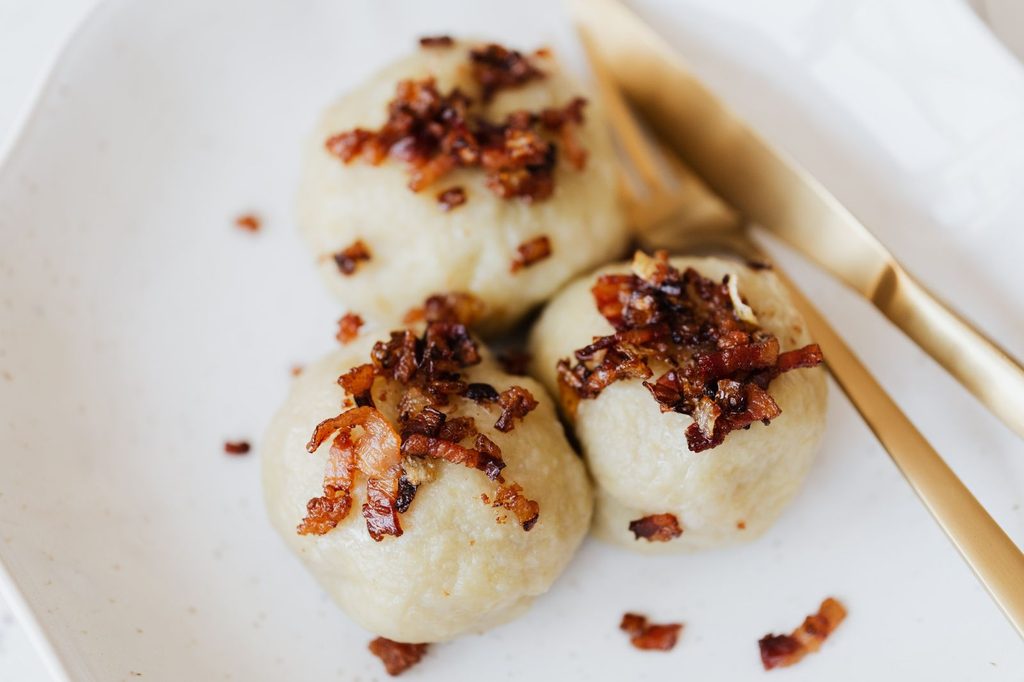
Slovak dishes took shape in mountain and farming regions, where the diet was based on simple, filling and cheap ingredients. That's exactly why traditional Slovak cuisine so often features potatoes, sauerkraut and dairy products made from sheep's milk. According to the official tourism portal Slovakia.travel, "milk, potatoes and cabbage" remain the basic components of the Slovak diet to this day.[1] In this guide we'll introduce the dishes you shouldn't miss during a visit to Bratislava, and we'll advise you on what to order and what to expect.
Article contents
Bryndzové halušky – the national dish
If you're going to try just one Slovak dish, let it be bryndzové halušky. These are small potato dumplings (dough made from grated raw potatoes and flour) coated in sheep's bryndza cheese and topped with crispy fried bacon. For Slovaks they mean something similar to what pizza means to Italians – they're a symbol of home cooking.[1]
Halušky spread among ordinary people relatively late, only during the 19th century, once potatoes became fully established in the diet. Their roots go back to sheep farming in the mountain regions of central and northern Slovakia (Liptov, Orava, Gemer), where the herding culture was brought by the so-called Wallachian colonisation from the Carpathian area.[2]
The key ingredient is bryndza – a soft, crumbly and spreadable cheese made from sheep's milk. Since 2008, "Slovenská bryndza" has been listed in the European Union register as a Protected Geographical Indication (PGI) and, according to the specification, must contain at least 50% sheep's milk.[3] It is bryndza that gives halušky their unmistakable salty flavour. Tip: if you don't like bacon, most places will happily leave it out.
Potato classics: strapačky, lokše, pirohy
Potatoes are everywhere in Slovak cuisine, and besides halušky they gave rise to a whole family of dishes.
- 🥬 Strapačky: the same dumplings, but mixed with braised sauerkraut instead of bryndza, often with pieces of smoked meat or cracklings. Hearty and tasty, ideal in the colder months.
- 🥞 Lokše: thin flatbreads made from potato dough, baked dry on a griddle. They're served savoury (with goose fat, cabbage or liver) and sweet (with poppy seeds or jam). They're an inseparable part of the goose feast.
- 🥟 Bryndzové pirohy: pasta parcels with a bryndza filling – right after halušky, one of the most popular home dishes. They're drizzled with butter and sometimes sprinkled with bacon.
- 🧇 Potato pancakes: crispy pancakes made from grated potatoes, flour and spices. They're eaten on their own or as a side to meat; you may also know them as "haruľa".
Soups and meat dishes
Slovak cuisine isn't only about potatoes – it also includes hearty soups and meat dishes that often reveal the influence of neighbouring cuisines.
Kapustnica is an iconic soup made from sauerkraut, smoked pork products, sausage and dried mushrooms. It's an inseparable part of the winter season and especially of the Christmas table – in the past it dominated because cabbage and potatoes were the basic winter stores. Every region (and indeed every family) has its own version.
Among meat dishes you'll often come across segedín goulash – pork braised with sauerkraut and cream, which has Hungarian origins and tastes best with a bread dumpling. Another Sunday-lunch classic is sviečková na smotane (beef sirloin in cream sauce) with dumplings, or roast meat with lokše. If you like cheese, you should try fried cheese with fries and tartare sauce, a favourite quick meal across the generations.
Sweet dishes and desserts
Traditional cuisine thinks of those with a sweet tooth too, and more than one sweet dish is served as a full main course.
- 🍰 Steamed buns (buchty na pare): fluffy yeast buns cooked in steam, filled with jam, sprinkled with poppy seeds or nuts and drizzled with melted butter.
- 🌾 Šúľance with poppy seeds: little rolls of potato dough coated in poppy seeds with sugar and butter – simple, but excellent.
- 🥛 Žinčica: a traditional whey drink made from sheep's milk, produced as a by-product of making sheep's cheese. You'll find it mainly in kolibas and at mountain sheep farms (salaš).
Quick overview of dishes
To help you find your way around the menu, we've summarised the best-known dishes in a table:
| Dish | What it is | Type |
|---|---|---|
| Bryndzové halušky | Potato dumplings with sheep's bryndza and bacon | Main course |
| Strapačky | Dumplings with braised sauerkraut | Main course |
| Bryndzové pirohy | Filled parcels with bryndza | Main course |
| Lokše | Thin potato flatbreads, savoury and sweet | Side / dish |
| Kapustnica | Soup of sauerkraut and smoked meat | Soup |
| Segedín goulash | Pork with cabbage and cream, with a dumpling | Main course |
| Steamed buns | Steamed yeast buns with jam and poppy seeds | Dessert |
Ingredients and names may vary slightly between restaurants – this is a rough guide.
Where to try them in Bratislava
Traditional Slovak cuisine is served in Bratislava by several restaurants in the centre and the surroundings. A legend among tourists and locals alike is Slovak Pub on Obchodná Street, one of the oldest and largest venues of this kind in the centre.[4] You'll also find an authentic atmosphere in koliba- or salaš-style venues, where halušky and žinčica are served just as they are in the mountains.
We've listed specific tips by budget and type of venue in the article Where to eat in Bratislava. If you want to combine food with exploring the city, our overview What to see in Bratislava or the itinerary Bratislava in 48 hours can help too. A glass of local wine also goes wonderfully with traditional dishes – you'll find tips in the article about the wineries in the Small Carpathians.
Check the opening hours, menu and prices of individual venues on their websites before your visit – they can change.
Accommodation with its own kitchen
On a multi-day stay it's pleasant to be able to prepare some dishes at home too – for example to buy bryndza at the market and try making your own halušky. You'll appreciate that in an apartment with its own kitchen, which gives you more freedom than a hotel room. If you want traditional restaurants in the centre within walking distance, CASTE on Zámocká Street by the castle is the right choice; for quieter surroundings with a good connection to the centre, SADBA on Ivánska cesta is a good fit. Each of our 8 apartments has a kitchen, parking included and a self check-in.
Frequently Asked Questions (FAQ)
What is the Slovak national dish?
Bryndzové halušky are considered the Slovak national dish – small potato dumplings coated in sheep's bryndza cheese and topped with fried bacon. They spread among Slovaks in the 19th century and today you'll find them in almost every restaurant serving traditional cuisine.
What is bryndza and what makes it special?
Bryndza is a soft, crumbly and spreadable cheese made from sheep's milk. Since 2008 Slovak bryndza has been listed in the European Union register as a Protected Geographical Indication (PGI) and must contain at least 50% sheep's milk. It gives bryndzové halušky their distinctive salty flavour.
Which traditional Slovak dishes should I try besides halušky?
Be sure to try strapačky (dumplings with sauerkraut), lokše (thin potato flatbreads), bryndzové pirohy (dumplings filled with bryndza), potato pancakes, kapustnica (a soup of sauerkraut and smoked meat) and segedín goulash. Among sweet dishes, steamed buns and šúľance with poppy seeds are popular.
Where can I try traditional Slovak dishes in Bratislava?
Traditional cuisine is served by several restaurants in the centre and the surroundings – for example the well-known Slovak Pub on Obchodná Street, as well as koliba- or salaš-style restaurants. Specific tips by budget can be found in our article Where to eat in Bratislava. Check the opening hours and menu before your visit.
Are traditional Slovak dishes suitable for vegetarians too?
Some are. Bryndzové halušky can be ordered without bacon, and bryndzové pirohy and potato pancakes are usually meat-free. On the other hand, kapustnica, segedín or strapačky with smoked meat are meat dishes. When ordering, it's worth asking whether the bacon or meat can be left out.
Conclusion
Traditional Slovak dishes are simple, filling and full of flavour – a perfect way to get to know the country through your plate. Start with bryndzové halušky, continue with strapačky, lokše and kapustnica, and leave room for steamed buns. In Bratislava you'll try them in traditional restaurants and kolibas, and on a longer stay you can prepare some of them in your own apartment. Take a look at all 8 apartments and choose a base for your culinary journey through Bratislava.
Sources
- Slovakia.travel – Slovak gastronomy (basic components of the Slovak diet, national dish). slovakia.travel/en/slovak-gastronomy (accessed August 2026).
- Bryndzové halušky – origin, history and Wallachian colonisation. en.wikipedia.org/wiki/Bryndzové_halušky.
- Bryndza – EU Protected Geographical Indication (PGI, 2008) and sheep's-milk share. en.wikipedia.org/wiki/Bryndza.
- Slovak Pub (Obchodná Street, Bratislava) – traditional restaurant. visitbratislava.com (check current opening hours).
The composition of dishes, prices and restaurant opening hours can change – check them directly with the specific venue before your visit.