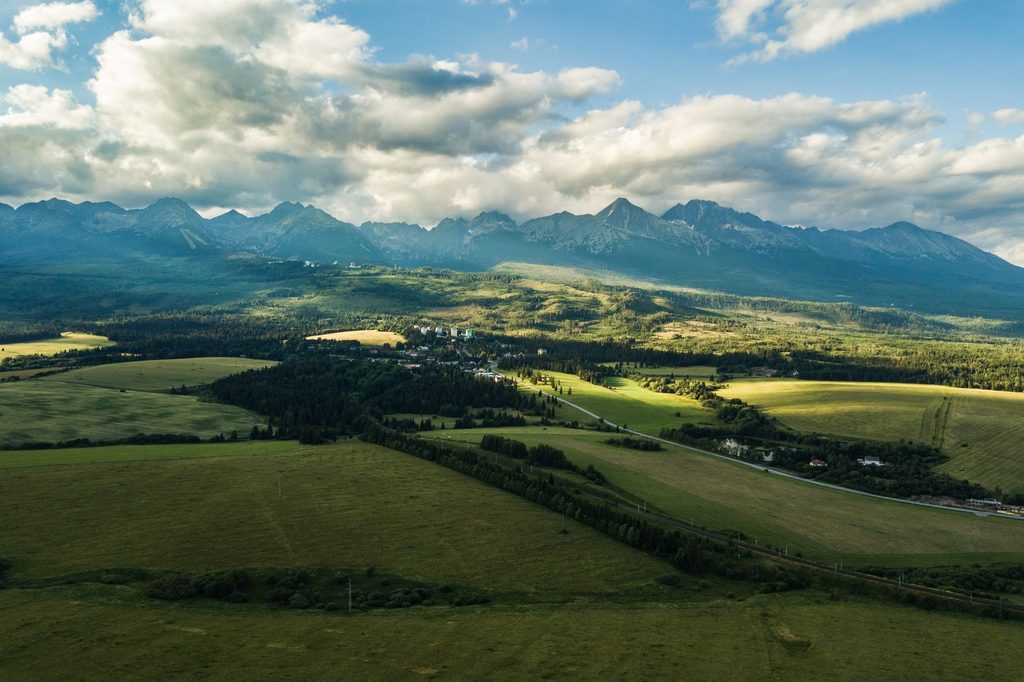
A first visit to Slovakia usually goes wrong for one reason: people plan too many places at once and then spend half the holiday sitting in a car or on a train. The country measures roughly five hundred kilometres from east to west, and a single journey across it eats up more time than visiting two towns put together, so the better question is what you can actually manage from one point. This article is therefore built as a plan for five to seven days with Bratislava as your base: what to sort out before you travel, which trips fit into a single day and at which moment it makes sense to pack up and move further east.
Article contents
Why Bratislava Makes a Good Base
For a first visit, Bratislava has one advantage no other Slovak city can match: it sits at the start of the main railway line that runs the length of the country all the way to Košice, and at the same time it is an hour by train from Vienna. From a single address you can reach the vineyards, a castle above the Danube, the spa towns and the Austrian capital, with your suitcase staying put the whole time.
Add to that the size of the city, which for a short stay is more of a strength than a weakness. You can walk the historic core in one afternoon, so you are not left with the feeling that you never properly saw the city itself, whereas two days in a larger metropolis leave you with scraps. If you want to get the most out of Bratislava before your first trip out of town, you will find a ready-made programme in the article Bratislava in 48 hours.
What is interesting is that the first UNESCO World Heritage site you come across is still inside the city. The Roman military camp of Gerulata in the Rusovce district was added in 2021 together with the other camps on the Danube Limes, while older Slovak entries such as Banská Štiavnica, Vlkolínec and Spiš Castle date back to 1993. [4]
What to Sort Out Before You Travel
Preparations for a first visit to Slovakia are shorter than people tend to expect, since the country is part of both the European Union and the eurozone. EU citizens only need a valid identity card to enter, while travellers from other countries should check the visa requirements on the website of the Ministry of Foreign Affairs of the Slovak Republic or with the relevant embassy. [3]
- Money: payment is in euros and cards are accepted even in smaller places, but small change comes in handy at farmers' markets and parking machines.
- Health: travel insurance with medical cover is recommended, the emergency number is 112 and pharmacies are usually open on weekdays from around eight to six, with one pharmacy in every town on duty at the weekend. [3]
- Water and electricity: tap water is drinkable unless a notice says otherwise, and the sockets are standard European ones with 230 V. [3]
- Ticks: if you plan to walk in the forests, vaccination against tick-borne encephalitis and a repellent are recommended, because there are more insects near water in summer. [3]
When you go matters more on a first visit than which landmarks you pick. The main tourist season runs from May to September, but for sightseeing in towns and cities May, June, September and October are the better choice, when it is not hot and there are fewer domestic tourists on the streets outside the summer holidays. The ski season begins in December and lasts roughly until March or April, so a winter date mainly makes sense if your plans point to the mountains. [3]
The last thing to settle before you arrive is the city card. Bratislava CARD covers admission to museums and galleries in the city and the region, a guided tour of the centre and a range of discounts, and it comes in two versions: with unlimited public transport it costs EUR 30 for 24 hours, EUR 36 for 48 hours and EUR 39 for 72 hours, while without transport it comes to EUR 27, EUR 32 and EUR 35. [5] Check the prices before you buy, because they change from time to time. Whether the card pays for itself depends on how many museums you really get round, and for a programme built on trips outside the city an ordinary transport ticket usually works out better.
The First Two Days Belong to the City
Do not overload the first day after you arrive, because finding your bearings in an unfamiliar city costs more energy than it seems. Walking the historic core, climbing up to the castle for the view over the Danube and picking somewhere to eat in the streets around the Main Square is plenty, and along the way you learn how to get around and where the stops are.
The second day suits whatever lies a little further from the centre and would not have fitted into the first evening: Devín Castle above the confluence of the Danube and the Morava, the riverfront with its modern districts, or one of the museums. You will find a full overview of the sights along with a suggested order in the article what to see in Bratislava, and the ruin above the river has an article of its own, the guide to Devín Castle.
If Bratislava grabs you enough that you would rather give it three days than two, take a look at the breakdown in the article Bratislava in 3 days. On a week-long stay that is a realistic option, because one trip can be dropped from the plan without the rest losing its shape.
Trips You Can Be Back From by Dinner
The third and fourth days belong to the surroundings, and this is where it becomes clear why the train beats the car in this part of Slovakia. The lines run straight into the town centres, you do not have to deal with parking, and after a tasting at a winery nobody has to worry about who is driving. The times below come from the timetable for an ordinary working day in September 2026 according to the journey planner. [2]
| Destination | Journey time by train | Changes | Why go there |
|---|---|---|---|
| Pezinok | 18 min | direct | the Small Carpathian wineries, half a day is enough |
| Trnava | 31 min by Ex express | direct | preserved town walls and many churches in a small core |
| Vienna | 56 min from the main station | direct | major galleries and imperial architecture |
| Piešťany | 1 h 07 min | direct | the spa island and a quiet promenade along the Váh |
| Trenčín | 1 h 18 min by Ex express | direct | a castle right above the town, a full-day trip |
| Žilina | 2 h 11 min | direct | the gateway to the northern mountains, borderline for one day |
| Poprad | 4 h 10 min by Ex TATRAN express | direct | the way into the High Tatras, an overnight trip |
| Košice | from 4 h 36 min, usually five and a half hours | direct | the second largest city, only worth several nights |
The table points to a simple rule: anything up to an hour and a half is a comfortable day trip, two hours is the limit, and beyond three hours you are talking about relocating rather than making a trip. The wineries in the Small Carpathians, complete with tasting tips, are covered in the article on wineries near Bratislava, while an overview of the lines and return services is in the article on train trips from Bratislava.
Vienna holds a special place in the planning, because it is a trip abroad that takes no longer than the journey to Trenčín. ZSSK sells the EURegio Wien Ticket return fare for it, valid on trains via both Marchegg and Kittsee, with bicycle carriage on the Bratislava to Vienna section included in the price, although a ticket bought online is only valid on the date you bought it for. [6] The details of this trip are in the article day trip to Vienna from Bratislava.
When It Pays to Move Your Base
The question that decides most on a first trip is whether to stay in one place for the whole visit. The answer depends on how long you are staying, because on a five-day stay moving swallows more time than it saves, while on a week-long stay the opposite is true.
In practice it looks like this. The direct express to Poprad takes four hours and ten minutes, so travelling there and back in one day would mean eight hours of sitting on a train and barely an afternoon in the Tatras. The fastest service to Košice takes four hours and thirty-six minutes according to ZSSK, but most direct expresses need around five and a half hours. [1] [2]
Banská Štiavnica is a special case: it is on the UNESCO list but has no direct rail connection, so you travel there with changes and the journey takes around four hours and twenty minutes. [2] Destinations like this are exactly where it shows that what counts is accessibility, not the distance on the map.
If you have a full week in Slovakia, the sensible answer is four nights in Bratislava and then two or three nights closer to the mountains. In winter that usually means a ski resort, and we write about Donovaly and what works there in the article on skiing in Donovaly, with accommodation right in the resort available at the DONIO apartment.
A Ready-Made Plan for 5 and for 7 Days
What follows is a breakdown you can use as it stands, or reshuffle according to the weather. The five-day version stays in Bratislava throughout, while the seven-day one moves on at the end.
Five days with a single base
- Day 1: arrival, the historic centre on foot, the view from the castle and dinner around the Main Square.
- Day 2: Devín or the riverfront in the morning, a museum in the afternoon and a calmer pace in the evening.
- Day 3: Trenčín or Piešťany by train, back in Bratislava for dinner.
- Day 4: Vienna for the whole day, or Pezinok with a tasting if you want a slower programme.
- Day 5: Rusovce with the Roman site of Gerulata, or the city markets, and departure.
Seven days with a move at the end
- Days 1 to 4: the same programme as above, only at an easier pace and with one extra day for the city.
- Day 5: the train to Poprad, with a first walk in the Tatras in the afternoon.
- Day 6: a full day in the mountains, on the slopes in winter and on one of the Tatra trails in summer.
- Day 7: the journey back, possibly with a stop in Žilina or Trenčín on the way.
If you like to plan the budget in advance, you will find sample amounts for accommodation, food and transport in the article how much a stay in Bratislava costs. More destinations in the area, including those reached by something other than a train, are summed up in the overview of day trips from Bratislava.
What Surprises First-Time Visitors
A few things are hard to read off a timetable, even though they can reshuffle your plan. These are worth knowing:
- Weekend services are different. Regional trains run less often at weekends, so a trip that works comfortably on a Wednesday can mean a long wait for the way back on a Sunday.
- Distances are deceptive. On the map the Tatras look close to Bratislava, but the line runs through the Váh valley and the journey is longer than the distance as the crow flies suggests.
- Shoes come off indoors. When you enter a Slovak home you leave your shoes in the hallway and guests are given slippers, which visitors from the west often find unusual. [3]
- Pharmacies keep shorter hours. On weekdays they usually close at six and at the weekend only one in town is on duty, so it is better to stock up on medicines in advance. [3]
On top of that there is one practical thing first-time visitors only realise once they are here: on a stay built around trips you spend mainly mornings and evenings at your accommodation, so having your own kitchen and being able to come back late without announcing yourself at a reception desk matters more than hotel services. That is exactly why an apartment works well for this kind of trip, as the article on the advantages of apartments over hotels explains.
Frequently Asked Questions (FAQ)
How many days are enough for a first visit to Slovakia?
Five to seven days works well for a first visit, because two days go to Bratislava itself and the rest is left for trips around the city plus one destination further away. For a shorter stay it pays to stick to Bratislava and its surroundings, since getting to the Tatras and back takes almost the whole day. If you have a full week, spend the last two nights somewhere else and keep Bratislava for the start of the trip.
Is it worth keeping Bratislava as your base for the whole stay?
For a stay of up to five days, yes, because direct trains to the Váh valley and to the east leave from the main station and you avoid packing up between one bed and the next. On a longer stay the logic changes, since the direct express to Poprad takes four hours and ten minutes and travelling there and back in one day no longer makes sense. A sensible compromise is to keep Bratislava as your base for the first four nights and move closer to the mountains for the rest.
How do I get from Bratislava to the High Tatras?
Poprad, the gateway to the High Tatras, is served by the direct Ex TATRAN express and the journey takes roughly four hours and ten minutes. From Poprad you continue to the individual Tatra resorts by rack railway or tram, so you do not need a car for it. Check the specific service in the timetable for your date of travel, because times differ at weekends and during engineering works.
When is the best time for a first visit to Slovakia?
The main tourist season runs from May to September, but the Slovak Tourist Board recommends May, June, September and October for visiting towns and cities, when it is not too hot and there are fewer people. The ski season starts in December and lasts roughly until March or April, so a winter date only makes sense if you are heading for the mountains. Spa towns are busiest from January to March.
Do I need a visa for Slovakia and what currency is used?
Citizens of the European Union only need a valid identity card to enter, while citizens of other countries should check the conditions on the website of the Ministry of Foreign Affairs of the Slovak Republic or with the relevant embassy. Payment is in euros, cards are widely accepted even in smaller places, but small change comes in handy at markets and for parking. The emergency number is 112 and tap water is drinkable, so there is no need to buy bottled water.
Conclusion
A first trip to Slovakia turns out best when you pick one place and use it properly instead of racing across the country. Bratislava handles that role precisely because it combines a small, easily walkable city with access to the main railway line and to the Austrian border, so from a single address you cover a surprisingly large slice of the country. Take a look at all 8 apartments and pick the one you would most like to set out from.
Sources
- Železničná spoločnosť Slovensko: shorter journey times for IC trains on the Bratislava to Košice route. zssk.sk (accessed September 2026).
- CP.sk journey planner: journey times from Bratislava main station for a working day in September 2026. cp.sk.
- Slovakia.travel: practical information for visitors (documents, health services, seasons, customs). slovakia.travel.
- Slovakia.travel: cultural monuments on the UNESCO World Heritage List. slovakia.travel.
- Bratislava CARD: card versions and prices with and without public transport. bratislavacard.com (accessed September 2026).
- ZSSK: conditions of the EUROPA REGIONAL WIEN TICKET return fare. zssk.sk.
Train times, card prices and opening hours change, so check them with the carrier and on the website of the specific place before you travel.