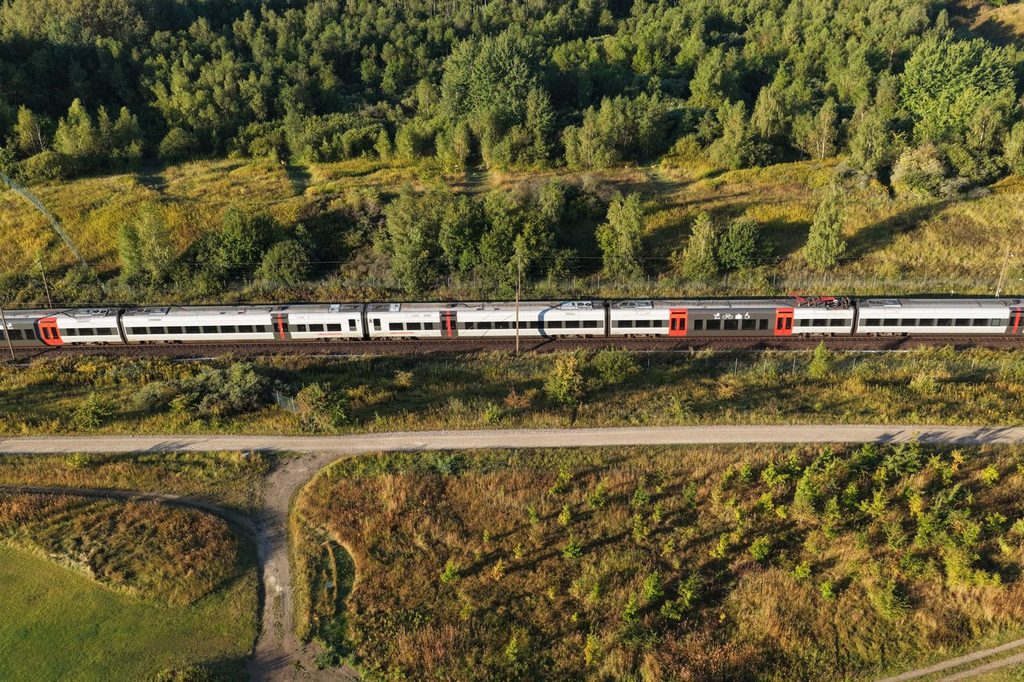
Train trips from Bratislava have one advantage a car cannot match: no hunting for parking in an unfamiliar town, and no question of who stays sober to drive after a wine tasting. Bratislava is also a railway hub with four directions of completely different character, so the choice is less about a single destination and more about which line you pick for the day. That is why this article is organised by railway line rather than alphabetically by town, because the line decides how often you can get back and how much time you actually have once you arrive.
Research confirms that the usefulness of a trip is not decided by distance alone. A study published in September 2025 in the journal Economies analysed the railway accessibility of rural tourism centres in Romania and found that the differences between destinations come mainly from whether a place has its own station and how many trains stop there during the day, with the type of train and the facilities at the station adding to it.[1] The same logic applies around Bratislava, where two towns at a similar distance behave completely differently depending on whether a train runs every hour or three times a day.
Article contents
- Four stations and four directions
- The Small Carpathians line: wine and vineyards
- The Váh valley line: spas and castles
- Záhorie and the Danube region
- Across the border: Vienna and Győr
- Tickets, prices and common mistakes
- How to plan the day around the return train
- Frequently Asked Questions (FAQ)
- Sources
Four Stations and Four Directions
Bratislava does not have one big station from which everything departs, and that is the first thing to know when planning a trip. Most services do leave from the main station, but some directions are served from other boarding points and the difference can be twenty minutes of extra walking.
- Bratislava hlavná stanica, the main station, is the starting point for the Small Carpathians, the Váh valley, Záhorie, Senec with Galanta and also for the trains to Vienna routed via Marchegg.
- Bratislava-Petržalka serves the second Vienna route via Kittsee, which is worth using for anyone staying on the right bank of the Danube.
- Bratislava-Nové Mesto is the boarding point for the local trains of line R55 towards Svätý Jur, Pezinok and Trnava, so from Ružinov you do not have to travel into the centre first.
- Devínska Nová Ves works both as a destination and as an interchange, because it lies on the Záhorie line and is only twelve to fifteen minutes from the main station.
The table below sums up the most popular destinations together with journey times. The times are based on the timetable for a normal working day in September 2026 according to the connection search engine, and they differ between individual services depending on the train category.[2] Check them for your exact date before you travel, because weekends and engineering works bring different figures.
| Destination | Journey time | Change | What it is good for |
|---|---|---|---|
| Devínska Nová Ves | 12 to 15 min | direct | Sandberg and Devínska Kobyla, half a day |
| Svätý Jur | 14 min from Nové Mesto | direct (Os trains only) | vineyards, historic centre, the Šúr reserve |
| Pezinok | 18 min | direct | wineries, the grape harvest festival, gateway to the Small Carpathians |
| Trnava | 31 min by Ex train, 42 min by R train | direct | town walls, churches, a full day |
| Piešťany | 1 h 07 min | direct | the spa island and relaxing by the Váh |
| Trenčín | 1 h 18 min by Ex train | direct | the castle above the town, a full-day trip |
| Vienna (Wien Hbf) | 56 min from the main station, 59 min from Petržalka | direct | major museums and galleries, a full day |
| Komárno | roughly 1 h 25 min | usually in Nové Zámky | the fortress system and the Courtyard of Europe |
| Nitra | roughly 1 h 55 min | in Trnava | the castle and Calvary, rather slow by train |
| Győr | from 1 h 45 min | two changes, or one via Vienna | baroque centre and thermal baths |
If more than one destination in the table appeals to you and you want to combine them into a longer stay, the overview article on day trips from Bratislava will help, as it also covers places reachable by car or by boat.
The Small Carpathians Line: Wine and Vineyards
For a day tripper the line towards Trnava is the most usable of all, because it runs below the ridge of the Small Carpathians and stops right in the wine towns. Trains here follow a regular clockface timetable and the journey is so short that it works even for an afternoon.
Svätý Jur in fourteen minutes
Svätý Jur is the nearest town where you can genuinely speak of countryside, and from Bratislava-Nové Mesto you get there in fourteen minutes on a local train. One important detail: express trains do not stop here, so pick the Os category in the search engine, otherwise the train will carry you straight on to Pezinok. Vineyards rise above the town with a view over the Danube Lowland, and on the other side lies the Šúr nature reserve with its wetland forest. The town has its own article, a day trip to Svätý Jur.
Pezinok and what lies beyond
Pezinok is eighteen minutes from the main station and express trains stop here too, which makes it the best-served destination in the area. The town is also an interchange for anyone heading deeper into the Small Carpathians, because suburban bus route 540 continues from the railway station through Modra all the way to Zochova chata.[3] That matters, because no train goes to Modra and the town was left aside when the railway was built, so the final stretch always has to be done by bus.
If your goal is a tasting at the winemaker's own cellar, take a look at the overview of wineries in the Small Carpathians. Modra itself, with its ceramics and the Štúr museum, is covered by a day trip to Modra.
Trnava as a full-day destination
Trnava is the last station where the integrated fare still applies, and the Ex express gets there in thirty-one minutes. You can walk around the town in half a day, since the historic core is ringed by a preserved belt of walls and it holds so many churches that it earned the nickname Slovak Rome. For a rail traveller Trnava has one practical advantage: there are plenty of services, so you will not be racing for the last train.
The Váh Valley Line: Spas and Castles
Beyond Trnava the same line continues up the valley of the Váh, and this is where the trips start to take a whole day. R category trains run hourly here and the Ex expresses overtake them on the longer sections.
Piešťany in one hour and seven minutes
Piešťany is the easiest full-day trip from Bratislava, because a direct express takes one hour and seven minutes and the spa island lies within walking distance of the station. You can build a programme here without any spa treatment at all, since the Colonnade Bridge, the park and the promenade along the Váh are enough for a calm afternoon. More detail is in the article on a day trip to Piešťany, or you can treat yourself once you are back to something from the overview of wellness and saunas in Bratislava.
Trenčín and the castle above the town
The Ex express reaches Trenčín in one hour and eighteen minutes, while the slower R express needs one hour and thirty-seven minutes. A difference of nineteen minutes sounds small, yet on a full-day trip it counts twice and that is almost three quarters of an hour extra. The castle is visible from the station and the climb up to it is short, so even if you arrive around midday you will manage both the tour and the town below. A detailed plan for the day is offered by a day trip to Trenčín.
Nitra and why the train is impractical
Nitra is the only regional capital nearby that comes off worse by train than by bus, because the main line bypasses it and the journey needs a change in Trnava. The total time runs to about one hour and fifty-five minutes, which is a lot for a distance of ninety kilometres. If you insist on Nitra, plan it as a full-day trip following the article on a day trip to Nitra, but expect the bus to be quicker.
Záhorie and the Danube Region
The remaining two directions are best for half a day, or for times when you want to get out of the city without a long journey.
Devínska Nová Ves and Sandberg
Twelve to fifteen minutes by train takes you to Devínska Nová Ves, from where you can walk up to Sandberg with its sandstone walls full of marine fossils. It is the fastest way to get from the centre into nature without changing trains, and it suits a late afternoon as well. The route and what to look for on Devínska Kobyla are described in the article on Sandberg and Devínska Kobyla. Devín Castle itself is not served by train, so you travel there by bus or by boat.
Komárno and the Danube region
There are two ways of reaching Komárno and the difference between them is considerable. The faster route goes via Nové Zámky with one change and takes roughly one hour and twenty-five minutes, while the direct regional express via Dunajská Streda needs over two hours. The direct service has its charm, though, because it crosses the Žitný ostrov and you do not have to watch for a connection. What to see in the town is summed up by a day trip to Komárno.
Across the Border: Vienna and Győr
Cross-border trips are the reason Bratislava is unusually well placed for travelling by rail. Two capital cities within an hour of each other are not something you find often in Europe.
Vienna in just under an hour
Two routes lead to Vienna and both are usable. From the main station the regional express runs via Marchegg to Wien Hbf in fifty-six minutes, from Petržalka you travel via Kittsee in fifty-nine minutes. Trains run hourly, so there is no point buying a ticket for one specific service and then chasing it. A programme for one day and tips on what to fit in are in the article a day trip to Vienna from Bratislava.
On price, the key thing is that ZSSK sells a discounted return ticket for this route, the EUROPA REGIONAL WIEN TICKET. On the Bratislava to Vienna section it costs EUR 18.50 for an adult and EUR 9.30 for a child aged six to sixteen in the e-shop and the mobile app, and a little more at the ticket office, namely EUR 19.00 and EUR 9.60.[4] The price also covers carrying a bicycle between Bratislava and Vienna, which will please anyone who wants to explore the city on two wheels. Watch the validity, because a ticket bought online is valid only on the day of purchase and the return journey has to end by four in the morning the following day, while a ticket from the office is valid for sixteen days.
Győr, and why Hainburg makes no sense by train
Győr in Hungary is reachable from one hour and forty-five minutes, but it requires two changes via Hegyeshalom. The more comfortable if longer option goes via Vienna with a single change and takes around three hours. The baroque centre and the thermal baths are described by a day trip to Győr.
Hainburg in Austria is a different case and it is worth mentioning precisely because the train is the wrong choice here. The rail connection makes a detour via Vienna and takes over two hours, even though the town lies fifteen kilometres from Bratislava. People use cross-border bus route 901 instead, where a single ticket costs EUR 2.50 and you buy it straight from the driver in cash or by card; on this route a dog, luggage and a bicycle also travel free of charge.[5]
Tickets, Prices and Common Mistakes
The ticketing system around Bratislava is split in two, and this is where most of the confusion arises. The integrated IDS BK fare applies within the Bratislava Region, while beyond its boundary you buy a standard ZSSK ticket.
Where the IDS BK ticket is valid
Integrated tickets are valid on Os and REX trains and on selected R expresses, and the system covers the lines towards Kúty, Devínska Nová Ves, Pezinok with Trnava, Senec with Galanta and the line to Rusovce.[6] One ticket therefore covers the tram into the centre, the train to Pezinok and the bus back, as long as you stay within the number of zones and the time limit.
| Validity | Zones | Paper | Electronic |
|---|---|---|---|
| 30 minutes | 2 zones (Bratislava) | EUR 1.20 | EUR 1.09 |
| 60 minutes | 2 zones (Bratislava) | EUR 1.80 | EUR 1.60 |
| 90 minutes | 3 zones | EUR 2.40 | EUR 2.12 |
| 120 minutes | 4 zones | EUR 2.90 | EUR 2.60 |
| 180 minutes | 6 zones | EUR 4.00 | EUR 3.63 |
| 300 minutes | no zone limit | EUR 6.10 | EUR 5.54 |
Prices of single IDS BK tickets valid from 1 July 2026 according to the overview on imhd.sk.[5] Electronic tickets can be bought in the mobile app or through the electronic wallet on a chip card.
The mistake that costs you a fine
The most common error visitors make is to buy a ticket by SMS or by tapping a bank card on a validator and then board a train with it. These two kinds of ticket are valid only on the city lines of Dopravný podnik Bratislava in zones 100 and 101, so on a train or a suburban bus you are travelling without a valid ticket.[5] For a trip, buy a paper ticket at a sales point or a machine, or an electronic one in the IDS BK mobile app.
The second thing people forget is the hundred per cent fare discount. It applies to children, pupils and students up to twenty-six years of age and to seniors from sixty-two years of age, on condition that the entitlement is registered with ZSSK. Children under six travel free in second class even without registration.[7] On regional trains there has been no need to collect a zero-fare ticket since August 2025, but on long-distance Ex, R and EC trains you still have to pick one up.
How to Plan the Day Around the Return Train
A rail trip is planned backwards, and that is the whole difference from going by car. First find the last sensible service home and only then build the programme, so that you are not checking your watch every ten minutes once you arrive.
- Choose the return service at a time that leaves you at least one fallback. If a train runs every hour, a small margin is enough; with three services a day, allow an extra hour.
- Subtract the walk from the station to the centre. In Trnava or Piešťany it is a short stroll, in Nitra or Komárno count on a longer transfer.
- Check the train category. Only local trains serve Svätý Jur, so an express will not drop you there and you will end up a station further on.
- Check for engineering works. At weekends and in summer part of the line is often replaced by a bus, which adds up to thirty minutes to the journey.
- Pack food and drink. Regional trains have no restaurant car and smaller stations are often closed.
When choosing accommodation, it pays to think about where you will be setting off from. Anyone planning several trips on the lines towards the Small Carpathians and the Váh valley will appreciate staying within reach of the main station, for example the CASTE apartment on Zámocká Street in the historic centre below the castle. Anyone heading mainly to Vienna via Kittsee is closer to the station in Petržalka. On a stay like this the kitchen in an apartment is a real advantage, because you prepare your snack for the train at home instead of hunting for one at the station; the other benefits are covered by the article on the benefits of apartments.
If you want to combine train trips into a longer programme, the itinerary Bratislava in 3 days will help, with the third day given over to getting out of the city. For moving around Bratislava itself, the overview of transport in Bratislava comes in handy.
Frequently Asked Questions (FAQ)
Where can you get to from Bratislava by train without a car?
A direct train takes you to Devínska Nová Ves in 12 to 15 minutes, to Svätý Jur in 14 minutes, to Pezinok in 18 minutes, to Trnava in 31 minutes on an Ex express, to Piešťany in one hour and seven minutes, to Trenčín in one hour and eighteen minutes and to Vienna in just under an hour. With one change you can also reach Komárno, Nitra and Győr in Hungary. These times apply to a normal working day, so check them for your exact date before you travel.
How long does the train journey from Bratislava to Vienna take?
The regional express from Bratislava main station via Marchegg reaches Wien Hbf in 56 minutes, from Bratislava-Petržalka via Kittsee it takes 59 minutes. Trains run hourly, so you do not have to tie yourself to one particular service. Both routes are direct, with no change.
Is a Bratislava public transport ticket valid on the train as well?
A standard IDS BK ticket is valid on Os and REX trains and on selected express trains within the Bratislava Region. It does not apply to a ticket bought by SMS or paid for by tapping a bank card on a validator, because those are valid only on the city lines of Dopravný podnik Bratislava in zones 100 and 101. For a train trip, buy a paper ticket or an electronic one in the IDS BK mobile app.
Can you reach Modra and Hainburg by train?
No train goes to Modra, because the town was left aside when the railway was built, and you travel there on suburban bus route 540, which leaves from the railway station in Pezinok. A rail connection to Hainburg in Austria does exist, but it makes a detour via Vienna and takes over two hours, so people use cross-border bus route 901 with a ticket for EUR 2.50.
How much does a return ticket from Bratislava to Vienna cost?
The discounted EUROPA REGIONAL WIEN TICKET return ticket costs EUR 18.50 for an adult and EUR 9.30 for a child aged 6 to 16 on the Bratislava to Vienna section if you buy it in the e-shop or in the ZSSK mobile app. At the ticket office it costs EUR 19.00 and EUR 9.60. The price also includes carrying a bicycle, but an online ticket is valid only on the day of purchase and the return journey has to end by 4:00 the following day.
Conclusion
Around Bratislava the train is an underrated way of getting about, even though it covers most of what people leave the city for. You reach the vineyards and the countryside in a quarter of an hour, a full day at the spa or below a castle in an hour, and the next capital city in just under an hour. All it takes is getting used to planning the day from the return service and checking the train category so that you do not end up at the wrong station. Take a look at all 8 apartments and choose according to the station you want to set off from.
Sources
- Jipa, A.-N., Lequeux-Dincă, A.-I., Teodorescu, C., Gheorghilaș, A., & Roangheș-Mureanu, A.-M. (2025). Railway Accessibility as an Opportunity for Rural Tourism Sustainability in Romania. Economies, 13(9), 270. doi.org/10.3390/economies13090270.
- CP.sk: train connection search engine, journey times verified for September 2026. cp.sk. The valid timetable is issued by Železnice Slovenskej republiky.
- imhd.sk: suburban bus route 540 Bratislava, Pezinok, Modra and Zochova chata. imhd.sk (accessed September 2026).
- Železničná spoločnosť Slovensko: EUROPA REGIONAL WIEN TICKET, prices and conditions. zssk.sk.
- imhd.sk: IDS BK travel tickets valid from 1 July 2026, including the fares for route 901 to Hainburg. imhd.sk.
- Železničná spoločnosť Slovensko: the integrated transport system in the Bratislava Region, list of the train lines included. zssk.sk.
- Železničná spoločnosť Slovensko: 100% fare discount, conditions and registration. zssk.sk.
Timetables, ticket prices and engineering works change. Before you travel, check both the service and the price for your exact date in the ZSSK or IDS BK search engine.